
Splitting Shared Expenses: How to Keep It Fair and Clear

The fairest way to split shared expenses is to first agree on which costs are genuinely shared, choose a model that suits your incomes—50/50, income-based contributions or pooling everything—and record it all in a shared household budget. A list of who paid for what and when is enough for a holiday with friends. But a couple or family paying rent, groceries and insurance every month needs more: a clear picture of income, fixed costs and what each person has left at the end of the month. That is exactly why we built KRONO, a private, iPhone-only finance app that lets you manage your household budget together, with local storage and optional private iCloud household sharing.
KRONO
krono.info
See your shared finances clearly
KRONO brings your budget, accounts, debts and cash flow together in one place, so you can get a clearer picture of your shared finances.
Visit KRONOAt a glance
- Make the list before doing the maths: Agree on which expenses are shared—rent, utilities, groceries and joint insurance—and which you each cover yourself.
- 50/50 works well with similar incomes. When earnings differ significantly, splitting costs in proportion to income is usually fairer.
- The formula: Your contribution = your take-home income ÷ combined take-home income × shared costs. In an illustrative example with take-home incomes of €2,100 and €2,900, the shares are 42% and 58%.
- Fewer transfers: Fund a joint account with standing orders, then settle shared expenses paid from personal accounts once a month.
- Review regularly: A pay rise, part-time work, parental leave or a child can change what is fair. A shared budget with a forecast helps you spot this in time.
Contents
- What actually counts as a shared expense?
- Three ways to split shared expenses
- How to calculate your share
- Joint account or separate accounts?
- Step by step: managing shared expenses day to day
- Settling up without endless transfers
- When life changes: children, parental leave and buying a home
- Our view: splitting costs is a budgeting question
- Your shared budget in KRONO
- Frequently asked questions
- Sources
What actually counts as a shared expense?
Before discussing percentages, you need a list. Many arguments about money start not with the split itself, but because one person considers a gym membership a personal expense while the other sees it as “health, so part of the household budget”. Finanztip recommends first deciding which expenses you will share, then reviewing the split regularly.
The following categories provide a useful starting point. Some examples reflect the German context of the sources:
| Category | Typical expenses | Who pays? |
|---|---|---|
| Housing | Rent including service charges, or mortgage payments; electricity, internet and Germany’s public broadcasting fee | Shared |
| Everyday essentials | Groceries, toiletries and cleaning products | Shared |
| Insurance | Home contents and personal liability insurance, if taken out jointly | Shared |
| Transport | Shared car: insurance, fuel and repairs | Shared or based on use |
| Children | Childcare, clothes, hobbies and pocket money | Shared |
| Personal spending | Clothes, mobile phone plans, hobbies and subscriptions used by only one person | Each person pays their own |
| Savings | Shared goals such as a holiday or a home deposit | Shared goals together; personal savings separately |
The joint-account recommendation reported by Verivox identifies precisely these core expenses: rent, utilities, groceries and joint insurance. Anything beyond that is open to discussion. The important thing is to write down your agreement once rather than debate it all over again every month.
For married couples in Germany, there is also a legal framework. Under Section 1360 of the German Civil Code (BGB), spouses must contribute appropriately to supporting the family through their work and assets. A spouse who manages the household generally fulfils their contribution through that work. Section 1360a BGB describes what family support includes: household costs, both spouses’ personal needs and the living expenses of their children. The law does not prescribe a calculation method, but it makes one thing clear: housework and childcare are real contributions, not “doing nothing”. These provisions are specific to Germany; legal rules elsewhere differ.
Three ways to split shared expenses
There is no single correct model—only one that suits your situation. These are three of the most common approaches in Germany:
| Model | How it works | A good fit when… |
|---|---|---|
| 50/50 | Each person pays half of the shared costs | You earn similar amounts |
| Income-based | Each person pays the same share of costs as their take-home income represents of your combined take-home income | Your earnings differ significantly |
| One shared pot | All income goes into the joint account, and the money left over is split equally | You see all income as shared money, for example when raising children |
50/50: simple, but not always fair
Going halves is easy to calculate and can feel fair. According to Finanztip, it makes most sense when both people earn roughly the same amount. If earnings are far apart—for example, illustrative gross monthly salaries of €4,000 and €1,800—you need to base major decisions, such as choosing a home, on the lower salary. Otherwise, the lower earner has very little left while the other person can save.
Income-based: the same burden, not the same amount
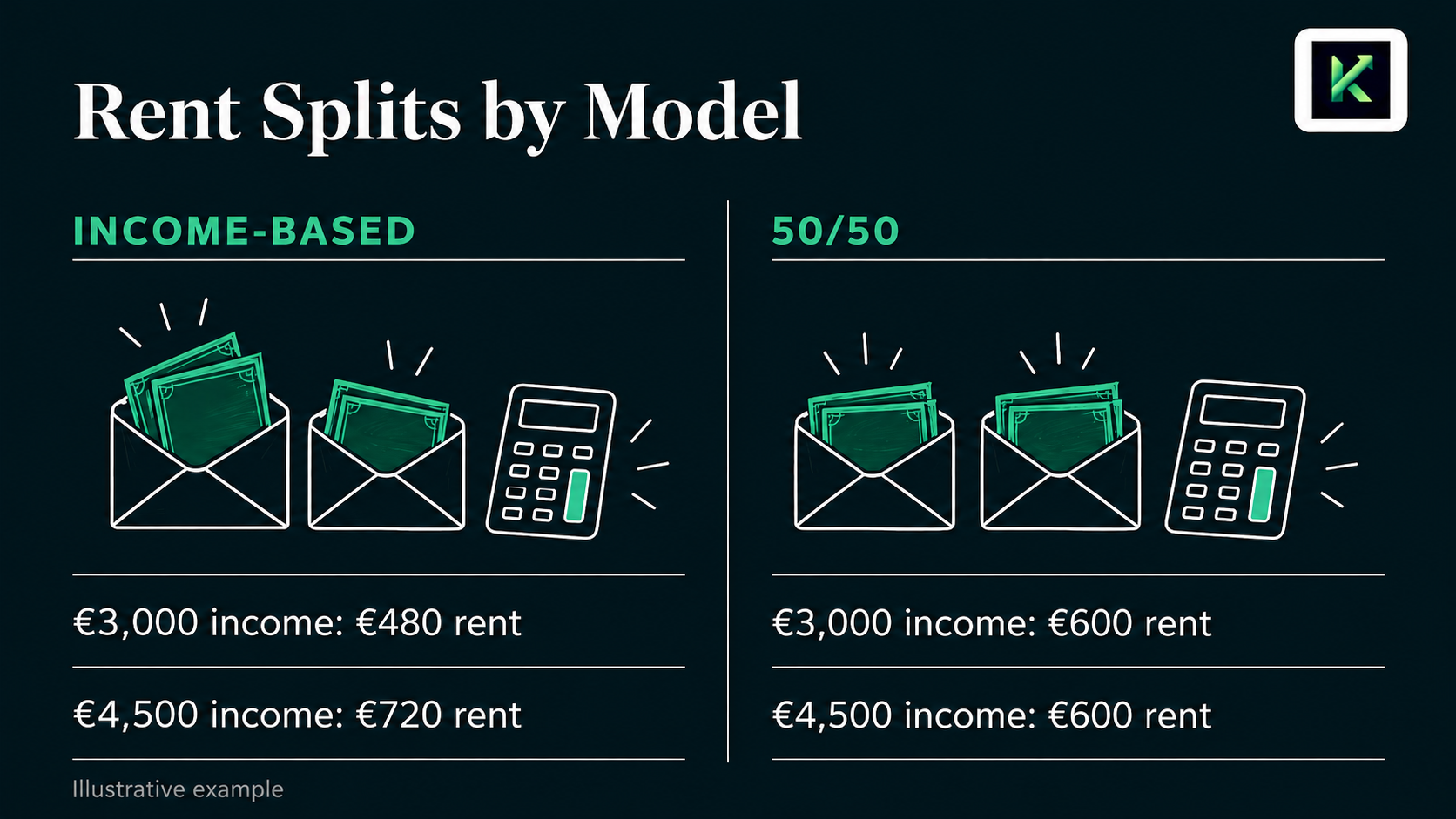
With this approach, each person contributes the same percentage of their income. Finanztip’s illustrative example uses gross incomes of €3,000 and €4,500 and rent including service charges of €1,200, giving a ratio of 2:3. One person pays €480 and the other €720. A 50/50 split would mean €600 each. The advantage is that you can afford a larger home together without pushing one person to their financial limit.
One shared pot: shared money, equal personal allowances
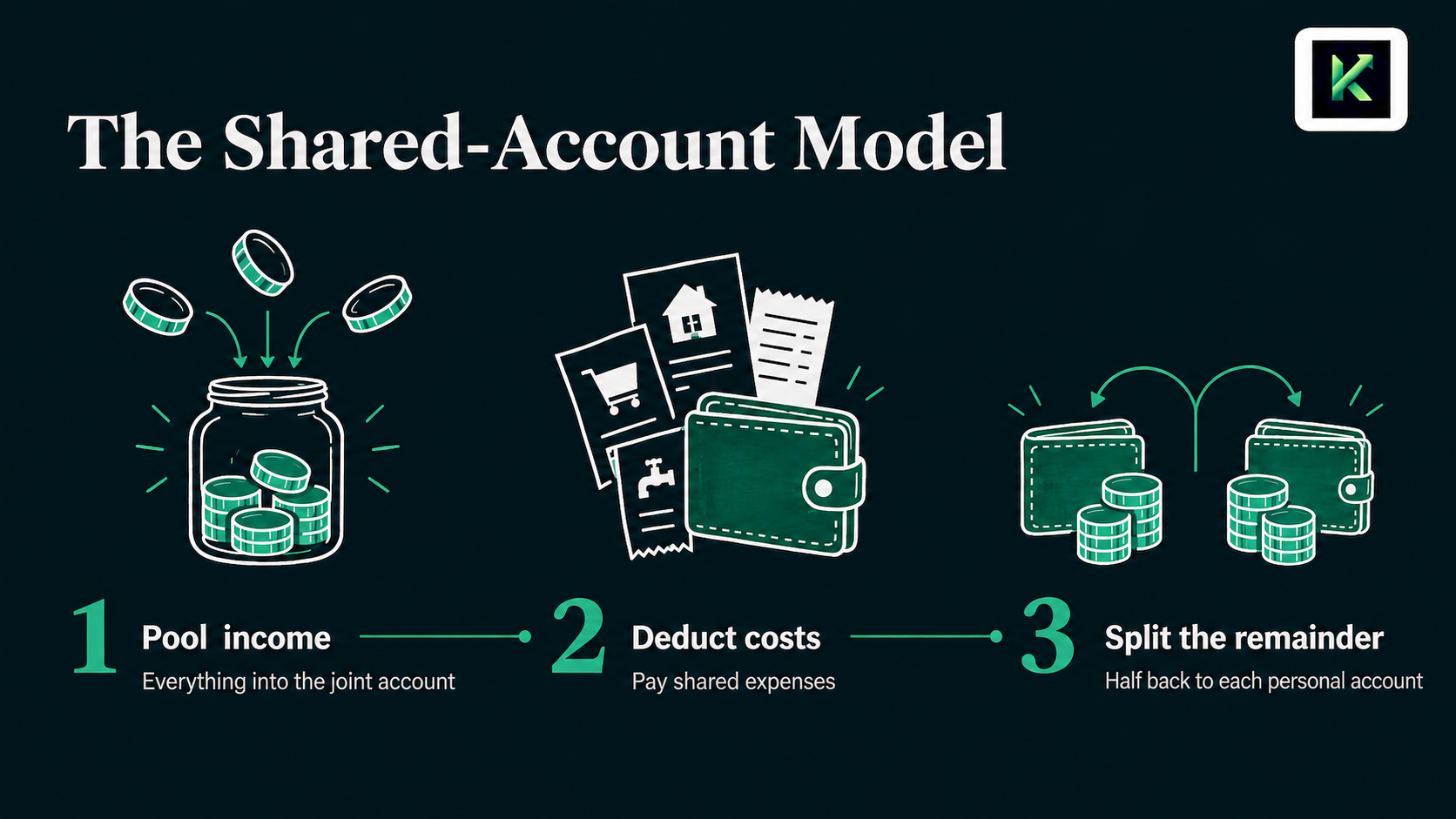
Consumer advocate Annabel Oelmann describes the reverse approach in Verivox’s report: all income goes into the joint account. After shared costs are deducted, the remainder is divided equally and transferred back to the personal accounts. Each person then has the same amount for personal spending, regardless of who currently earns more. This is often the fairest model for families where one person works part-time.
How to calculate your share
Here is an illustrative worked example using take-home pay, because that is the money that actually reaches your account. All example amounts remain in euros:
- Lena earns €2,100 net and Jonas earns €2,900 net. Combined income: €5,000.
- Their monthly shared costs are €1,350 for rent including service charges, €650 for groceries and toiletries, and €400 for electricity, internet, insurance and holiday savings. Total: €2,400.
Step 1: Calculate the percentages. Lena: 2,100 ÷ 5,000 = 42%. Jonas: 2,900 ÷ 5,000 = 58%.
Step 2: Calculate the contributions. Lena: €2,400 × 0.42 = €1,008. Jonas: €2,400 × 0.58 = €1,392.
Step 3: Compare what each person has left.
| Model | Lena contributes | Lena has left | Jonas contributes | Jonas has left |
|---|---|---|---|---|
| 50/50 | €1,200 | €900 | €1,200 | €1,700 |
| Income-based | €1,008 | €1,092 | €1,392 | €1,508 |
| One shared pot | €2,100 | €1,300 | €2,900 | €1,300 |
The table makes visible what couples otherwise argue about based on feelings alone: with a 50/50 split, Jonas has almost twice as much discretionary money as Lena. Which model you choose is up to you. But now you can make that decision using numbers rather than instinct. In the shared-pot row, the contributions are their full incomes paid into the joint account; the remaining money is then split equally.
Another useful check when choosing a home: according to Finanztip, rent including service charges should ideally be no more than roughly 30% of take-home income. For Lena and Jonas, €1,350 is 27% of their combined take-home income, so it falls within that guideline. Our 50/30/20 budget calculator helps you work out a sensible monthly split between fixed costs, wants and savings in just a few minutes.
Joint account or separate accounts?
The three-account model works well for many couples: two personal current accounts and one joint account, with both partners transferring their agreed contribution by standing order. Rent, electricity and insurance are paid from that account, and you use the joint-account card for groceries. That means no more settling up over every supermarket receipt.
When opening an account, understand which type you are choosing. In an interview with NWZ, a consumer advocate recommends distinguishing between Germany’s “Und-Konto” and “Oder-Konto”. With the more common “Oder-Konto”, either account holder can act independently; with an “Und-Konto”, both must act together. With an “Oder-Konto”, both are generally liable for an overdraft, even if only one person caused it. Account types and liability rules vary by country, so check the terms with your bank before signing and agree on whether—and to what extent—you will use an overdraft.
A joint account is practical, but it does not answer the most important question: is there enough money, and how will that change over the coming months? For that, you need a view of all your accounts, including personal ones, and upcoming fixed costs.
Step by step: managing shared expenses day to day
- Be open about income. Both of you should share your take-home income, including regular extras such as child benefits or a second job. Without that figure, any split is guesswork. In KRONO, you enter your income and accounts in one place and see what is available to your household.
- Define your shared expenses. Use the table above as a starting point, removing or adding items to suit your situation. A common mistake is forgetting annual costs such as car insurance or an additional utilities payment after the annual reconciliation. Divide these costs into monthly amounts.
- Choose a model and calculate contributions. Pick 50/50, income-based contributions or one shared pot. Write down the amounts so there are no different interpretations later.
- Create a budget and record spending. This is where most agreements fall apart: after three months, no one knows whether the grocery budget is enough. With KRONO, you can keep your household spending record as a couple or family together. Optional private iCloud household sharing lets you both see the same figures, with local storage on your devices and sharing through your private iCloud. Enter expenses manually or import them by CSV. In Germany only, KRONO Pro also offers an optional bank connection through Salt Edge.
- Check in monthly. Set aside ten minutes once a month: does the budget still work, who paid for shared expenses from personal funds, and is a settlement due? KRONO’s monthly PDF financial report gives you a consistent basis for that conversation.
- Look ahead. The cash flow forecast lets you look up to 24 months ahead to see whether your split will still work if loan repayments rise or one income disappears. Read more in our guide to cash flow forecasting for iPhone.
Settling up without endless transfers
Even with a joint account, one of you may occasionally pay for the weekly groceries using a personal card. Rather than reimbursing every purchase immediately, record these expenses and settle up once a month. You end up with just one transfer.
Here is how it works in our illustrative example with Lena and Jonas and their 42/58 split:
- During the month, Lena paid €340 of shared expenses from personal funds, and Jonas paid €180. Total: €520.
- Lena’s share: €520 × 0.42 = €218.40. She paid €340, so she contributed €121.60 too much.
- Jonas’s share: €520 × 0.58 = €301.60. He paid €180, so he contributed €121.60 too little.
- Result: Jonas transfers €121.60 to Lena. Done.
With a 50/50 split, the calculation is even simpler: each person owes €260, so Jonas transfers €80. For this to work, expenses need to be recorded accurately; otherwise, settling up becomes a memory test. If you prefer not to connect your bank, our guide to a budget app without bank access explains how to keep manual entry quick.
When life changes: children, parental leave and buying a home
A split that is fair today may no longer be fair in a year. The most common triggers are:
- Parental leave and part-time work. When one income falls, an income-based split automatically changes each person’s share. With 50/50, the partner on parental leave can quickly come under financial pressure. Our guide to parental leave and household budgeting explains how to plan for this period. For married couples in Germany, the principle in Section 1360 BGB applies: managing the home and caring for children are contributions to family support.
- Salary changes. A promotion changes the balance. Recalculate your percentages whenever either salary changes.
- Buying property together. Buying a home involves a deposit, mortgage payments and registered ownership—far more than everyday running costs. Record each person’s contribution in writing and get legal advice, for example from a notary where appropriate. Prepare the financial side with our guide to buying a home and planning your deposit.
In KRONO, you can include life events such as having a child, buying a property or retiring directly in your financial plan and see how they could change your budget before they happen.
Our view: splitting costs is a budgeting question
When couples argue about shared expenses, it is rarely about, say, the €80 spent on the weekly groceries. It is about one person feeling they carry more of the burden, while neither can back it up with figures. A list of who owes whom resolves the individual transaction, but not the underlying question.
That is why we built KRONO not as a bill-splitting tool, but as a shared overview: income, expenses, accounts, debts, net worth and cash flow in one place. When you can see what each person has left after fixed costs, and how that could develop over 24 months, you make decisions about the split differently—and more calmly.
It matters to us that your finances remain your business. Data is stored locally on your devices, with optional sharing through your private iCloud household sharing. And the basics remain available without a subscription. Our financial score assesses your situation using seven factors, so you can see not just who pays what, but how well your household is positioned financially.
Thomas
Your shared budget in KRONO
KRONO brings your household budget, accounts and forecast to iPhone—for both of you. Optional private iCloud household sharing lets you work with the same figures, with data stored locally and shared through your private iCloud. KRONO Free is free forever for up to 3 accounts, 2 loans and 1 monthly budget, giving you an overview with forecasting even without bank access.

If you need more, you can upgrade to KRONO Pro. In Germany, Pro costs €6.99 a month or €69.99 a year; prices elsewhere vary by region. Pro adds unlimited accounts and loans, advanced planning tools such as Monte Carlo simulation, and—in Germany only—optional automatic bank imports through Salt Edge. In other countries, use manual entry or CSV imports. Any Pro AI features are off by default, require a compatible iPhone and Apple Intelligence, run on-device and require confirmation before taking actions. See all the details on our pricing page.
Frequently asked questions
Is a 50/50 split fair when incomes differ?
It is equal in monetary terms, but often does not feel fair. When incomes differ significantly, the lower earner has much less discretionary money—in the example above, €900 rather than €1,700. An income-based split means both contribute the same proportion of their income.
Which app works well for managing shared expenses as a couple?
Couples and families benefit from an app that covers the whole household budget rather than just splitting individual receipts. KRONO brings your budget, accounts, debts and cash flow forecast together in one place on iPhone and can be used together through optional private iCloud household sharing. The basic version is free forever for up to 3 accounts, 2 loans and 1 monthly budget.
Gross or net income: which should you use to calculate contributions?
For ongoing expenses, net income is usually the better basis because it is the money you actually have available. Different tax categories or deductions can distort the proportions if you use gross income. Above all, make sure you both use the same basis.
How often should we review the split?
At least once a year and whenever there is a major change: a new salary, part-time work, parental leave, moving home or having a child. A quick monthly budget check helps you spot an imbalance early.
What is the easiest way to settle up?
Record all shared expenses paid from personal funds and settle them once a month. The difference between what each person paid and what they should contribute results in just one transfer. A joint account funded by standing orders keeps these situations to a minimum.
Sources
- Finanztip: Expenses in your relationship—is 50/50 fair?
- Verivox: The advantages of a joint account
- NWZ: Joint accounts—advantages and risks