
Plan Your Financial Future: Your Financial Plan in 8 Steps

Planning your financial future starts with answering three questions: Where do I stand today, what is coming up over the next few months, and where do I want to be in five, ten or thirty years? Looking at individual accounts will not give you the full answer. You need your income, expenses, debts, assets and cash flow in one place, along with a forecast that looks ahead. That is exactly why we built KRONO: a private, iPhone-only finance app that brings these elements together and creates a forecast for up to 24 months. This guide takes you through building your financial plan step by step, whether you are planning on your own, as a couple or as a family.
At a glance
- A financial plan starts with an honest assessment: your income, expenses, debts and assets in one clear overview.
- The order matters: first protect yourself against major risks, pay off expensive debt and build an emergency fund of two to three months’ take-home income. Then save for your goals and retirement.
- Goals become realistic when you calculate the amount, deadline and monthly contribution, rather than simply writing them down.
- Couples and families plan better with a shared overview that both partners can see and maintain.
- Review your plan once a year and adapt it to your life, rather than overhauling it every month.
Contents
- What a financial plan can do for you
- Build your financial plan in 8 steps
- Planning together as a couple or family
- Our view: planning needs clarity and privacy
- Start your financial plan with KRONO
- Frequently asked questions
- Sources
What a financial plan can do for you
A personal financial plan is not a document to tuck away in a drawer. It is a tool for feeling more confident day to day and making progress over the long term. In its background guide to financial planning, Germany’s consumer advice organisation, Verbraucherzentrale, identifies three core elements: protecting yourself against risks that could threaten your financial security, following the rule “Do not spend money you do not have”, and setting aside an emergency fund. If your car breaks down or an electricity bill adjustment is higher than expected, you can draw on that cushion instead of your overdraft.
The second benefit is about the future. Once you know how much money is left each month, you can work out when you will have saved enough for a car, a home deposit or parental leave. Without that figure, every goal remains a wish.
For context, private households in Germany saved 10.3% of their disposable income in the first half of 2025, on a seasonally adjusted basis, according to Germany’s Federal Statistical Office. That is an average across all households, not a target for you. Your own savings rate depends on your financial position, which is exactly where your plan begins.
Build your financial plan in 8 steps
1. Take stock: put everything on the table
Verbraucherzentrale Bremen calls this an income and expenses check: compare your monthly income with your expenses, then record your assets and loans, including each loan’s outstanding balance, payment and interest rate. The central question is: where is my money actually going?
Where things go wrong: many people count only their current account. They leave out their easy-access savings, home savings contract, instalment loan for the sofa and credit card. The resulting picture is either too rosy or too bleak. In KRONO, you record accounts, loans and assets in one place. The app uses them to calculate your net worth: everything you own minus everything you owe. Our net worth calculator can also help you get a quick initial figure.
2. Create a budget and spread out fixed costs
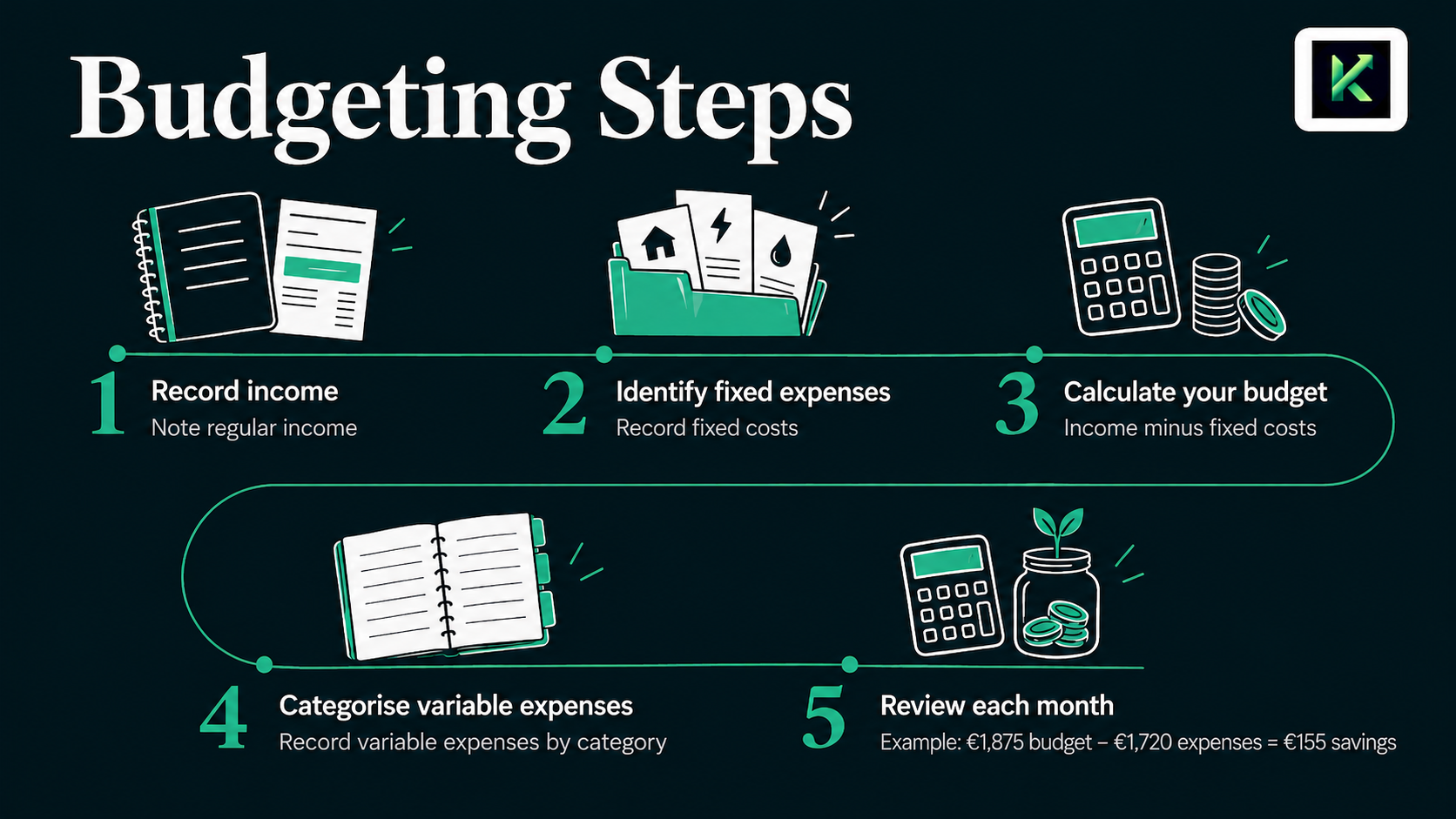
The Verbraucherzentrale guide to keeping a household budget describes five steps: record regular income, identify fixed expenses, calculate your available budget (income minus fixed costs), log variable expenses by category, and review the totals once a month. Convert annual costs, such as vehicle tax, into a monthly amount and set that money aside. In Verbraucherzentrale’s illustrative example, a budget of €1,875 minus expenses of €1,720 leaves €155 for savings.
Where things go wrong: the insurance payment in March, Germany’s quarterly broadcasting contribution, the Christmas present. If you do not spread these items over twelve months, you face the same “surprises” every year. According to Verbraucherzentrale, you only need to complete the first two steps once, unless something changes. After that, the task is to keep your records up to date. If you want a simple split as a starting point, our 50/30/20 budget calculator shows how your take-home income divides between needs, wants and savings. You can find a worked example in our guide to budgeting on €2,500 take-home income.
In KRONO, you can enter expenses manually or import them via CSV. In Germany only, Pro also offers an optional bank connection through Salt Edge for automatic imports. In other countries, use manual entry or CSV. Trend-based insights show you which spending category is growing before it breaks your budget.
3. Build your emergency fund
As a rule of thumb, Verbraucherzentrale suggests keeping two to three months’ take-home income in reserve. Self-employed people with fluctuating income, or older people with foreseeable care needs, may need more. As an illustrative example, with take-home income of €2,400 a month, that means €4,800 to €7,200 in an account you can access quickly.
If you support parents whose care needs are increasing, it is also worth checking which benefits could ease the pressure on the family budget. For readers in Germany, this overview of benefits for care grade 2 explains the relevant support. Include these amounts as regular income or expenses in your plan so that ongoing costs do not eat into your emergency fund.
4. Pay off expensive debt first
Loan interest is usually higher than the return on savings. In an illustrative comparison, Verbraucherzentrale sets a loan charging up to 5% interest against an investment returning 0.5%. In that situation, every euro you put towards repaying the loan does more for you than the same euro in a savings account. That is why paying off debt comes before investing.
Where things go wrong: several small loans and instalment purchases run side by side, and no one remembers which is the most expensive. In KRONO, you record each loan with its payment and interest rate. The cash flow forecast shows the month when a payment ends and how much room that frees up in your budget. Read more in our guide to planning assets, debts and cash flow.
5. Give each goal an amount, a deadline and a monthly contribution
“Save more” is not a goal. “Add €12,000 to my home deposit in 36 months” is. In this illustrative example, that works out at approximately €333 a month, rounded. Check whether that contribution fits the budget you created in step 2. If it does not, move the deadline, lower the target amount or look for room in your variable expenses. That is how goals become realistic.
It helps to group goals by time horizon:
| Time horizon | Typical goals | What matters |
|---|---|---|
| Up to 2 years | Emergency fund, holiday, new car, parental leave | Security and quick access |
| 2 to 10 years | Home deposit, children’s education | Predictable monthly contributions and risk suited to the deadline |
| Over 10 years | Retirement savings, building wealth | Consistency, costs and staying the course |
Major life events change all the numbers at once. In KRONO, you can add them to your plan as life events, such as having a child, buying a property or retiring, and see how your cash flow changes afterwards. You will find practical calculations in our guides to parental leave and household budgeting and planning your deposit for a home purchase.
6. Look ahead: see the next 24 months
This is where a spending log differs from a financial plan. A spending log shows what happened. A plan shows what is coming: when your balance might get tight in autumn because insurance and vehicle tax fall due together, when a loan ends, or whether you will have enough money for your summer holiday.
KRONO uses your income, fixed expenses and loan payments to create a cash flow forecast for up to 24 months. For longer-term questions, KRONO Pro offers a Monte Carlo simulation: the app runs through many possible scenarios and shows a range rather than a single figure. This helps you assess how resilient a goal is. Our article on the cash flow forecasting app for iPhone shows what this looks like in practice.
7. Approach retirement planning in the right order
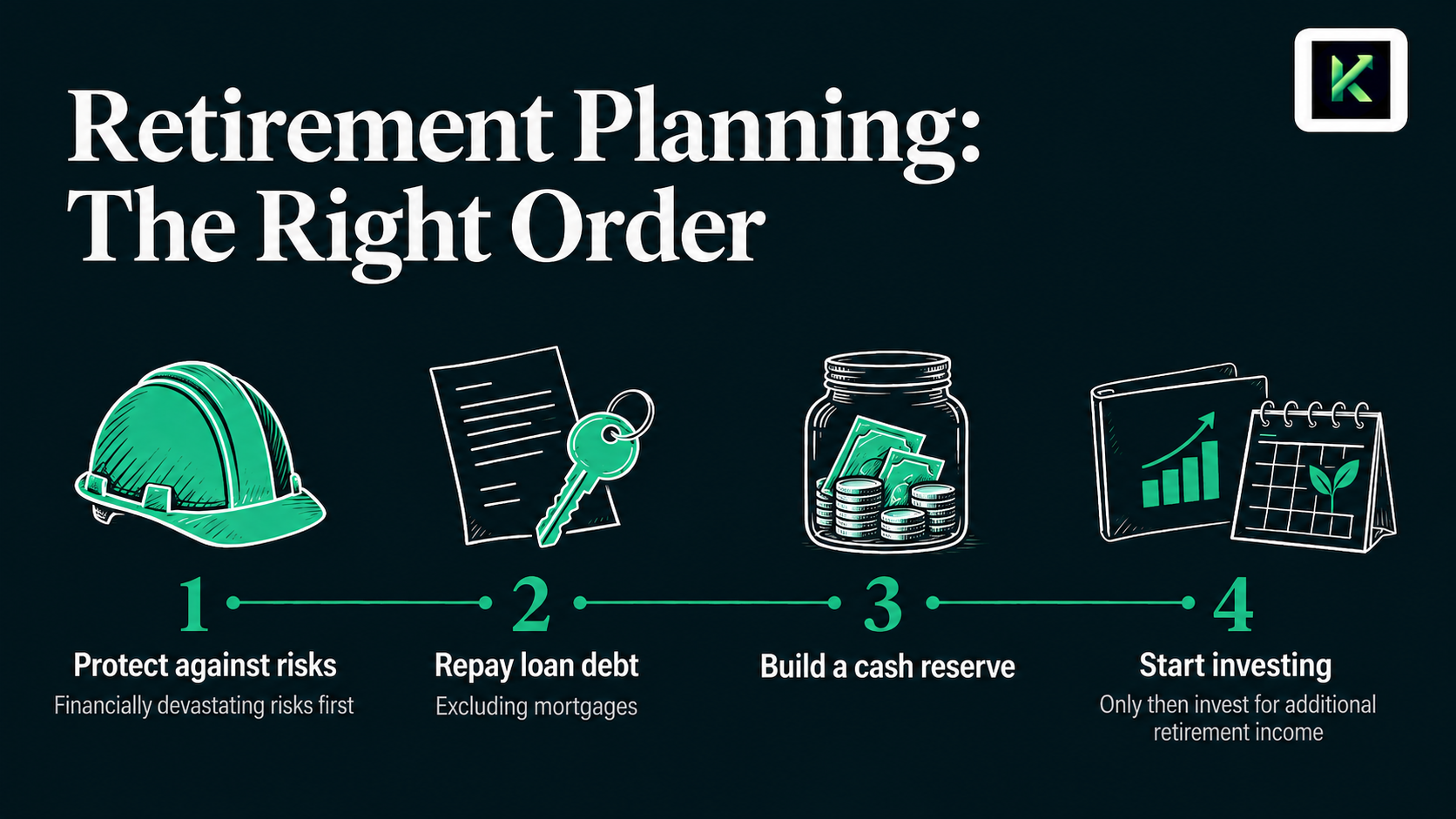
Verbraucherzentrale Niedersachsen recommends a clear sequence: first protect yourself against risks that could threaten your financial security, then repay loan debt other than mortgages and build a cash reserve. Only then should you start investing for additional retirement income. Your income, job security, age and investment horizon determine how much risk you can afford to take. Its guiding principle is: “Small amounts of wealth need a high level of security.”
In Germany, a reform of government-supported private retirement provision is planned. According to the linked FAQ attributed to the Federal Ministry of Finance, new products could be offered from 1 January 2027, including retirement investment accounts without a guarantee and a standard product. The proposals include allowances that rise with your own contributions, a child allowance of up to €300 per child, and a one-off early-career bonus of €200 for contracts taken out before your 25th birthday. The government draft of the Retirement Provision Reform Act from December 2025 also proposes allowing withdrawal plans lasting at least until age 85, alongside lifelong annuities. Check the Federal Ministry of Finance for the latest status; these are Germany-specific proposals, not universal benefits. Independent advice, for example from Verbraucherzentrale, can help you decide which product suits you. For your plan, the first question is how much you can sustainably contribute each month, and your cash flow provides the answer.
8. Review and adjust once a year
Verbraucherzentrale recommends checking at least once a year how your finances are doing, whether your circumstances have changed fundamentally, and whether your investments still fit. Frequent switching, by contrast, mainly adds costs.
Choose a fixed date, perhaps in January, and also review your plan after every major event: a job change, move, birth, inheritance or separation. KRONO’s monthly financial report, available as a PDF, helps you keep a record and compare results. The financial score assesses your position using seven factors, so you can see at a glance whether your situation is improving.
Planning together as a couple or family
Once two incomes and shared costs are involved, planning becomes a conversation. Verbraucherzentrale Hamburg also sees an honest assessment of your finances as the first step for families. Then agree on three things:
- Which costs are shared? Rent, energy, groceries, insurance, childcare and holidays.
- Who contributes how much? Equal amounts, or a share based on income. When salaries differ, many people find an income-based percentage fairer.
- Which goals do you share? A household emergency fund, a home deposit or savings for the children. Personal spending remains personal.
Where things go wrong: one person maintains the spreadsheet and the other never looks at it. Then the plan is not shared; it is one partner’s project. It will only work if both people can see the same figures. KRONO offers optional private iCloud household sharing for this: you share your household through iCloud on your iPhones. This is an optional cloud-sharing feature, not a claim that shared data never uses cloud infrastructure. Our guide to household budgeting for couples and families explains how couples and families can divide up their budgeting.
For families, life events deserve particular attention. A second child, returning to work after parental leave or switching to part-time work can change your budget for years. Including these phases in your forecast helps you spot tight periods early and build up savings in time.
Our view: planning needs clarity and privacy
In our experience, financial uncertainty is rarely just a lack of discipline. More often, people lack a clear overview. Their money is spread across three accounts, the loan is with another bank, investments are somewhere else, and annual costs are not in any calendar. Planning like that means planning in the dark.
That is why we built KRONO to bring budgets, accounts, debts, net worth and cash flow together in one place. A financial plan only becomes useful when it looks ahead. That is why our focus is a forecast of up to 24 months, not just a look back at last month.
Who controls your financial information matters just as much to us. Your data is stored locally on your device. If you choose, you can share it with your partner or family through private iCloud household sharing. And because financial clarity should not depend on the size of your wallet, there is a permanently free basic version with no subscription required, supporting up to 3 accounts, 2 loans and 1 monthly budget. For deeper planning, you can upgrade to KRONO Pro. Optional bank imports through Salt Edge are available only in Germany; elsewhere, you use manual entry or CSV.
Thomas
Start your financial plan with KRONO
You can put the eight steps above into practice directly in KRONO on your iPhone. With KRONO Free, you can record income, expenses and accounts to build a comprehensive overview, free forever and without a subscription, with up to 3 accounts, 2 loans and 1 monthly budget. KRONO Pro costs €6.99 per month or €69.99 per year in Germany; prices elsewhere vary by region. Pro unlocks unlimited accounts and loans and advanced planning tools, including Monte Carlo simulation. The optional bank connection for automatic imports is available only in Germany through Salt Edge. In other countries, use manual entry or CSV. Any Pro AI features are off by default, require a compatible iPhone and Apple Intelligence, run on-device and require confirmation before actions are carried out. Safe to Spend is an estimate, not a guarantee.

You can find full details of the versions on the KRONO pricing page.
Frequently asked questions
What is a financial plan, in simple terms?
A financial plan is an overview of your income, expenses, debts and assets, combined with your goals and calculations showing how to reach them. It helps you plan protection against risks, build an emergency fund and see how much you can set aside each month for your goals. In short, it turns wishes into monthly contributions.
How much should I keep in an emergency fund?
Verbraucherzentrale suggests two to three months’ take-home income as a rule of thumb. If you are self-employed, have fluctuating income or expect care costs, plan for more. The money should be easy to access, for example in an easy-access savings account.
Should I pay off debt or save first?
Start with a small emergency fund so you do not have to take on new debt. Then pay off expensive borrowing, such as instalment loans or an overdraft, because the interest usually exceeds investment returns. Mortgages are treated separately in this approach and can continue alongside building wealth.
How often should I review my financial plan?
Review it thoroughly once a year, and whenever a major life event occurs, such as a job change, birth or move. Keep your budget up to date throughout the year, but avoid constantly changing your investment strategy, because frequent switching adds costs.
Can we maintain a shared financial plan as a couple?
Yes, and it works best when both of you can see the same figures. Agree on which costs are shared, who contributes what proportion, and which goals you share. In KRONO, you can do this using optional private iCloud household sharing.
Sources
Verbraucherzentrale: Background information on financial planning (2022)
Verbraucherzentrale Bremen: Income and expenses check (2024)
Verbraucherzentrale: Keeping a household budget
Verbraucherzentrale: Investing and retirement planning
Verbraucherzentrale Niedersachsen: Investing and the “magic triangle”
Verbraucherzentrale: The basics of investing
Verbraucherzentrale Hamburg: Household budgeting for families
Federal Statistical Office: Savings rate in the first half of 2025
Federal Ministry of Finance: Government draft of the Retirement Provision Reform Act (December 2025)