
Planning Your Wedding Budget: How to Keep Costs Under Control as a Couple

A wedding budget starts with your household finances, not a list of prices. First, answer three questions: How much do you already have? How much can you put aside each month before the wedding? And when will the major deposits be due? Answer these before choosing your venue, guest list and photographer, and you can plan a celebration that leaves your finances in good shape afterward, too. This is where a finance app such as KRONO can help you keep track of your income, expenses and a forecast for up to 24 months together. Here, you’ll find the figures, a step-by-step calculation and a complete example budget.
At a glance
- According to the Wedding Report 2026, couples in Germany spent an average of €17,006 on their wedding, excluding honeymoons and engagement rings.
- Start by reviewing your finances and monthly savings capacity, not your wish list of prices. Your budget is what you can realistically put together before the date.
- Guest numbers have the biggest impact, because food, drinks, stationery and often venue size increase with each person.
- Allow a 10% contingency fund and establish when deposits will be due so your monthly budget doesn’t slip into the red.
- Record every wedding expense on the same day in one shared place. That way, you always know what’s left.
Contents
- What a wedding costs in Germany
- Calculate your wedding budget in five steps
- A wedding budget example with figures
- Sticking to your wedding budget: how to stay on track
- Where to save without sacrificing what matters
- Why a finance app offers more than a wedding spreadsheet
- Our approach to wedding budgets
- Frequently asked questions
- Sources
What a wedding costs in Germany
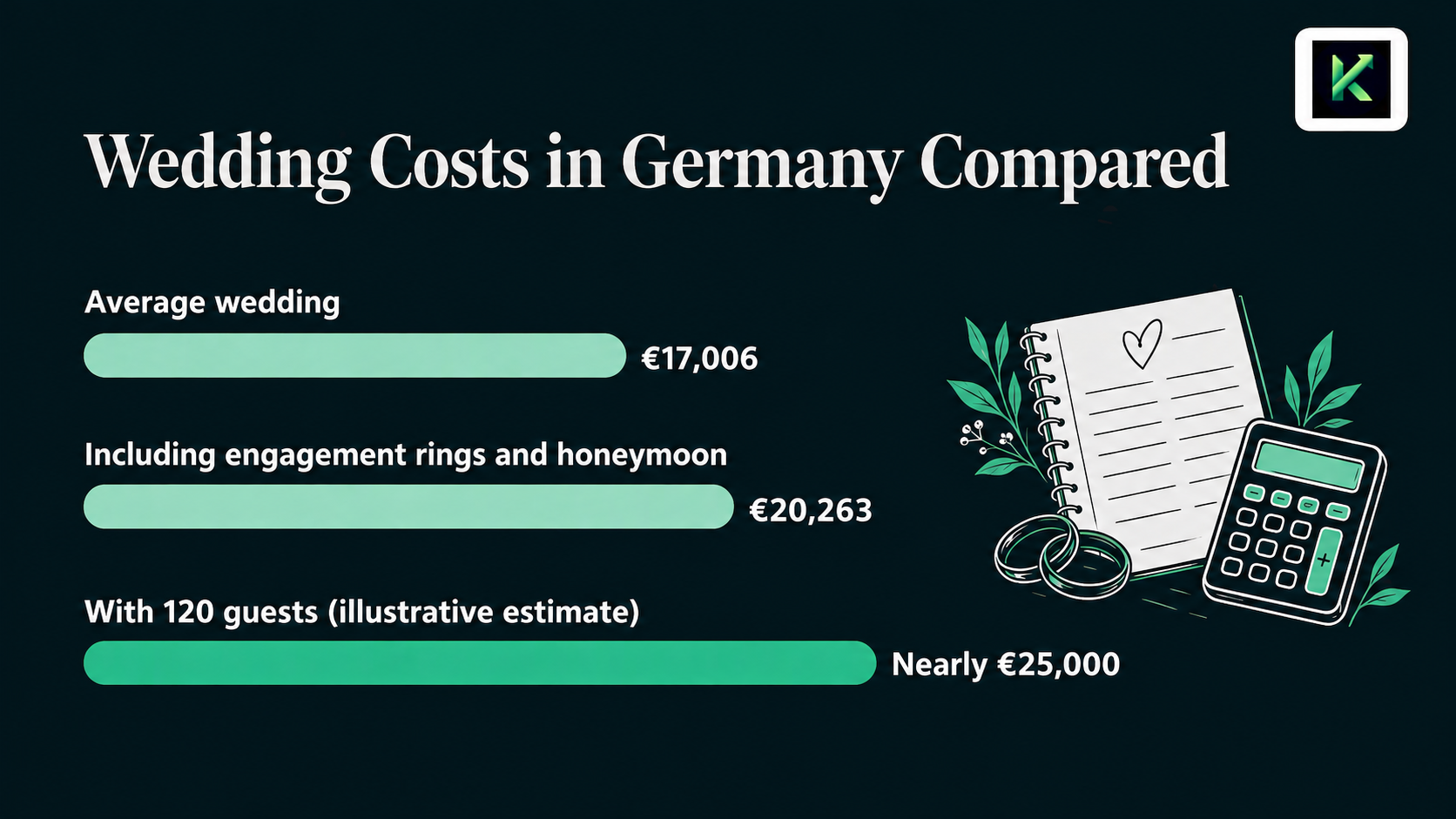
A realistic benchmark is a useful starting point. More than 2,000 German couples were surveyed in 2025 for the Wedding Report 2026. The average wedding cost €17,006. Including honeymoons and engagement rings brings the total to €20,263. These are German figures, not estimates of wedding costs in other countries.
Guest numbers are just as revealing. According to the same survey, couples celebrated with an average of 82 people; it also reports 72 attending the ceremony and 20 additional evening guests. These reported averages should not be treated as an additive breakdown. Dividing €17,006 by 82 guests gives roughly €207 per person. This isn’t a price a venue will quote you, but it is useful for a quick sense check: if you’re planning for 120 guests, that average already puts you at nearly €25,000.
What matters is how you interpret the average. It isn’t a target or a minimum. A civil ceremony with 30 guests and a restaurant meal costs a fraction of that, while a barn wedding with 150 guests can cost several times as much. The figure simply gives you a sense of the scale of spending for many couples and how much time you may need to save.
Calculate your wedding budget in five steps
Most couples start with the wedding dress or dream venue, then work backward. A better approach is the reverse: money first, wishes second.
1. Take stock: what do you have today?
Write down the savings you both have, which accounts they’re in and how much is genuinely available for the wedding. An emergency fund for a washing machine, car repairs or a job change doesn’t belong in your wedding budget. If you’re also saving for a home, consider both goals side by side. Our guide to buying an apartment and planning your deposit explains how this works for the money you contribute toward a property purchase.
Where things go wrong: Each of you knows only your own account balance. You end up counting money twice or forgetting an outstanding loan. In KRONO, you can keep accounts, debts and net worth in one place and optionally share your household privately through iCloud. That way, you both see the same figures.
2. Monthly savings: how much can you add before the wedding?
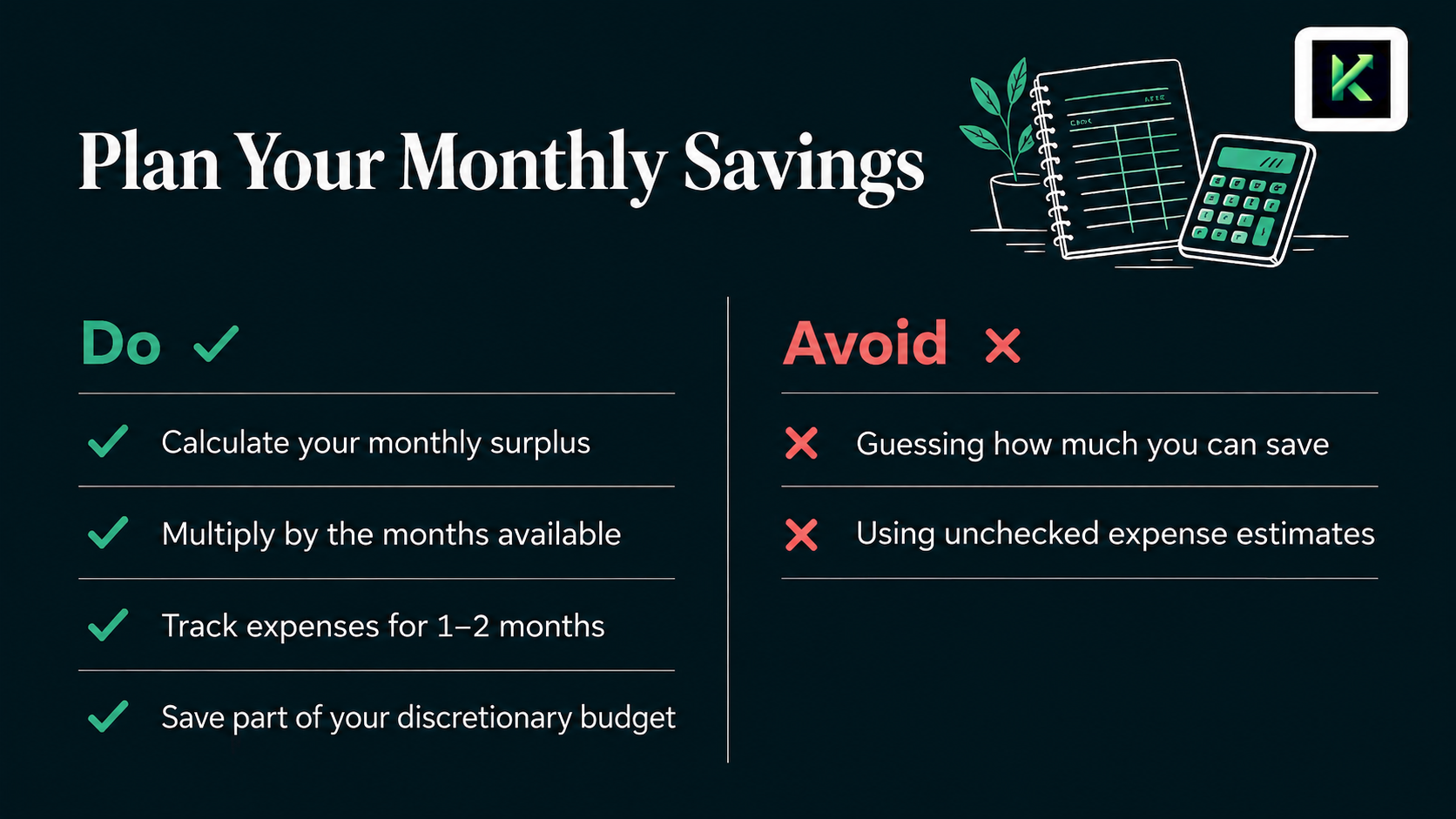
Calculate how much is left each month after rent, fixed costs and everyday spending, then multiply that by the number of months until the wedding. If you don’t yet have a set allocation, the 50/30/20 budget calculator can help: it divides your take-home income into fixed costs, discretionary spending and savings. In the run-up to a wedding, many couples deliberately move some discretionary spending into savings.
Where things go wrong: Monthly savings are guessed rather than measured. If you don’t know your actual spending over recent months, you’re planning around a figure that may never have existed. Start by recording your real expenses for one or two months, manually or through CSV imports. In Germany only, KRONO Pro also offers an optional bank connection via Salt Edge; bank connection is not available in other countries.
3. Confirm family contributions
Parents or grandparents often contribute to a wedding. Discuss this early and be specific: how much, when and for which expense? You can’t build a plan around “Of course we’ll help.” An illustrative commitment such as “€3,000 by the end of March toward the venue” gives you something concrete to work with. Don’t include cash gifts received on the wedding day in your budget, because most bills will need to be paid beforehand.
4. Set aside a contingency fund
Reserve around 10% of your combined savings, planned monthly contributions and family support as a contingency fund. It covers the things that crop up in almost every wedding plan: late RSVPs, suppliers’ travel and accommodation, corkage, tips or a second fitting. Allocate the rest across your spending categories.
5. Use that figure to decide on guest numbers and format
Only now should you decide how big the celebration will be. Roughly divide the budget available to allocate by your preferred guest count. If the amount per person is well below the average of around €207, you have three options: fewer guests, a different format, such as lunch instead of an evening buffet with an open bar, or a later date that gives you more months to save.
A wedding budget example with figures
Here’s an illustrative example to make the calculation more tangible. Lena and Jonas want to get married in 15 months with 80 guests. Together, they have €5,000 available for the wedding, their parents are contributing a combined €3,000, and a review of their finances shows they can save €600 a month.
| Component | Amount |
|---|---|
| Existing savings | €5,000 |
| Family contribution | €3,000 |
| Monthly savings: €600 × 15 months | €9,000 |
| Total budget | €17,000 |
| Contingency fund included above (10%) | €1,700 |
| Available to allocate | €15,300 |
Here’s how they could divide the €17,000. These amounts are our illustrative calculations, not market prices. Get your own quotes for each category and enter the actual figures.
| Category | Amount | Share |
|---|---|---|
| Food and drinks (around €70 per guest) | €5,600 | 33% |
| Venue and hire costs | €2,800 | 16% |
| Clothing, styling and accessories | €2,000 | 12% |
| Photographer | €1,700 | 10% |
| Music or DJ | €900 | 5% |
| Decorations and flowers | €900 | 5% |
| Wedding rings | €900 | 5% |
| Invitations, stationery and miscellaneous items | €300 | 2% |
| Civil registry fees and documents | €200 | 1% |
| Contingency fund | €1,700 | 10% |
| Total | €17,000 | 100% |
Percentages are rounded and may not add up to 100% individually.
The allocation is revealing: costs charged per guest make up a third of the budget here. That’s why a shorter guest list can save more than cutting back on decorations.
The catch in this example: deposits are due early
On paper, the plan works. But venues and photographers often ask for a deposit when you book, which means in the early months, when you’ve accumulated only a small portion of your planned savings. If Lena and Jonas pay a €1,400 venue deposit and €500 photographer deposit in month two, their existing savings cover it. If the dress deposit falls due in month four, alongside the annual car insurance bill, things get tight.
That’s why every deposit needs a date in your plan, not just an amount. A cash flow forecast for up to 24 months can show you which month your projected balance will be lowest before you sign a contract.
Sticking to your wedding budget: how to stay on track
Creating a budget takes an evening. Sticking to it for a year is the real work. These rules can help:
- Agree on three priorities. Each of you names the two or three things that matter most to you, such as photos, good food or live music. Deliberately spend more on your shared priorities and stick to the plan elsewhere.
- Record every expense immediately. That includes €40 for place-card craft supplies or a trial hairstyle. Small amounts often determine whether your contingency fund is enough once they’re added together.
- Compare quotes by total price. Ask every supplier about travel, VAT, overtime and additional charges. Always record the final amount, not the base price.
- Reallocate rather than overspend. If one category becomes more expensive, take the money from another. Your contingency fund is for unexpected costs, not upgrades.
- Review the budget together once a month. Fifteen minutes is enough: what have you spent, how much have you saved, and is the forecast still above zero? This helps you spot changes while you still have time to respond.
- Don’t forget everyday life. The wedding sits alongside rent, groceries and holidays. If you look only at the wedding list, you may notice too late that your everyday bank balance is shrinking.
For couples who already manage their finances together, now is a good time to start tracking household spending jointly. Our guide to household budgeting for couples and families explains how to make it work without arguments.
Where to save without sacrificing what matters
Saving doesn’t mean trimming a little from everything. It means making firm choices in the right places so there’s enough left for your priorities.
- Guest list: Every person you leave off the list saves food, drinks, an invitation, a wedding favor and a seat. A clear rule helps, such as inviting only people you’ve seen in the past year.
- Day and season: Depending on the supplier, a Friday or a date outside the summer months may cost less than a peak-season Saturday. Ask specifically about price differences between dates whenever you request a quote.
- Drinks: A fixed-price package is easier to budget for than paying according to consumption. Find out whether you can bring your own drinks and what fees apply.
- Format: Lunch or coffee and cake with a larger group after the civil ceremony, followed by an evening with a smaller circle, costs less than an evening celebration for everyone.
- Decorations and stationery: These are often the best areas for DIY, because materials are inexpensive and friends may be happy to help. Still, include every purchase in the budget.
- Clothing: Buying secondhand, renting or choosing a previous season’s design can reduce costs—and no one will know on the day.
Don’t let the money you save simply disappear into other spending. Reallocate it deliberately: to your priorities, your contingency fund or your life after the wedding.
Why a finance app offers more than a wedding spreadsheet
A spreadsheet of items and prices tells you what the wedding costs. It doesn’t necessarily tell you whether you can afford it, when money will be tight or how much of your savings will remain afterward. For that, you need a view of your entire household’s finances.
With KRONO, you plan your wedding budget in the same place you manage your other finances. You record income and expenses, add accounts and debts, and use a cash flow forecast looking up to 24 months ahead to see how monthly savings and deposits affect your projected balance. Optional private iCloud household sharing lets you maintain the figures together. KRONO is iPhone-only, with data stored locally on your iPhone; enabling household sharing also uses your private iCloud, so it is not accurate to describe shared data as staying only on the device.

KRONO Free is free forever for up to 3 accounts, 2 loans and 1 monthly budget, giving you an overview without a subscription. In Germany, KRONO Pro costs €6.99 per month or €69.99 per year; prices elsewhere vary by region. Pro features include unlimited accounts and loans, planning tools with Monte Carlo simulation, and—in Germany only—an optional bank connection via Salt Edge that imports transactions automatically. In other countries, use manual entry or CSV imports. You can find all the details on the KRONO pricing page.
Our approach to wedding budgets
We see a wedding for what it is financially: one of the first major goals two people save toward together. That’s why we’re not keen on planning it in a separate list that disappears into a folder after the celebration.
When you plan your wedding within your real household budget, you also learn how managing money together works: who contributes what, how much you can genuinely save each month, and what a loan or deposit does to your balance six months from now. That’s exactly why we built KRONO, with forecasting, a financial score and private household sharing for couples.
Life continues after the wedding: a home, a child, retirement. KRONO offers dedicated planning for life events like these. If you already use KRONO to plan your wedding, you have the foundation in place for your next goals.
Thomas
Frequently asked questions
How much should you budget for a wedding?
As much as you can put together before the date from existing savings, monthly savings and firmly promised contributions, with around 10% reserved as a contingency fund. For context, couples in Germany spent an average of €17,006 according to the Wedding Report 2026, excluding honeymoons and engagement rings. That’s a benchmark, not a requirement.
How do you calculate a wedding budget per guest?
Divide the budget available after setting aside your contingency fund by your planned guest count. For comparison, the reported total average of €17,006 divided by 82 guests works out to around €207 per person, before any separate contingency deduction. If your figure is significantly lower, adjust the guest count, format or date.
When should you start saving for your wedding?
As soon as you have an approximate date. The more months you have, the less you need to save each month. It also becomes easier to cover early deposits from money you’ve already put aside.
Which finance app is suitable for a wedding budget?
Look for an app you can use together that shows more than expenses: accounts, debts and a forecast, too. KRONO brings these together on iPhone, with optional private iCloud household sharing and a free version covering up to 3 accounts, 2 loans and 1 monthly budget.