
Organize Your Finances: 6 Steps to a Clear Financial Picture

Organizing your finances means bringing everything together in one place: income, fixed and variable expenses, accounts, debts, savings and your plans for the months ahead. An expense tracker alone is not enough, because it only looks backward. With a finance app like KRONO on your iPhone, you can see your budget, net worth and cash flow together and plan up to 24 months ahead. Your data is stored locally on your device, with optional private iCloud syncing and household sharing, and the basic version is free. Here are the six steps, in an order that works.
At a glance
- Gather first, plan second: Bank statements, payslips and contracts are the foundation of any household budget.
- Divide annual costs by 12: Set aside a monthly share of insurance premiums and other annual fees so the payment does not leave a hole in your budget.
- Start with 50/30/20: Allocating 50% to fixed expenses, 30% to wants and 20% to savings goals is a useful starting point.
- Build a buffer before chasing returns: Two to three months’ salary in an easy-access savings account can cushion unexpected expenses.
- One place for everything: Bringing your budget, debts, assets and forecasts together in one app helps you stay on top of things, including as a couple or family.
Contents
- What organized finances look like
- Step by step: how to organize your finances
- How to divide up your money sensibly
- Planning savings buffers and goals
- Organizing finances as a couple or family
- Paper, spreadsheet or app: what works long term?
- Your finances in one place with KRONO
- Our view: getting organized means looking ahead
- Frequently asked questions
- Sources
What organized finances look like
Many people have money spread across three accounts, a car loan, a home savings contract and no idea how much is really left at the end of the month. The problem is rarely a lack of discipline; it is a lack of visibility. Hamburg’s consumer advice center points out that spending money with a card, phone or watch is now very easy, and ongoing contracts with installment payments can quickly become hard to keep track of.
Your finances are organized when you can answer five questions at any time:
- How much money comes in each month?
- How much of it is already committed?
- What do I spend the rest on?
- What do I own, what do I owe, and what does that make my net worth? (Net worth is everything you own minus everything you owe.)
- What will my account balance look like in six, twelve or 24 months if things continue as they are?
A traditional household spending log answers the first three questions. The last two need somewhere that brings accounts, loans and future plans together. That is what separates a pile of paperwork from a genuinely organized financial picture.
Step by step: how to organize your finances
Germany’s consumer advice service describes five steps to a personal household budget: income, fixed expenses, available budget, variable expenses and a monthly review. We start by gathering the paperwork and finish by looking at assets and debts, because only then is the picture complete.
1. Gather your paperwork
Before entering a single number, get together everything that affects your money. In its printable household budget book, the Rhineland-Palatinate consumer advice center lists bank statements, payslips, your rental agreement, service-charge statements, electricity and gas bills, and insurance premiums.
Where things go wrong: Contracts billed only once a year are almost always overlooked. Go through the last twelve months of bank statements and highlight every payment that is not monthly: car insurance, Germany’s broadcasting contribution, annual subscriptions and membership fees.
This is where you set up your accounts and loans in KRONO. With KRONO Pro, you can automatically import transactions through the optional bank connection for German banks via Salt Edge, rather than typing them in. Bank connections are available only in Germany. Elsewhere, or if you prefer not to grant bank access, use manual entry or CSV import.
2. Record your income
Write down all regular income: wages or salary, child benefit, parental benefits, maintenance payments and rental income. Germany’s national debt advice association recommends usually looking at the past three months. Looking at a full year is worthwhile if your income varies significantly by season, as it can for self-employed people or those working in hospitality.
Where things go wrong: Christmas and holiday bonuses are often spread across the monthly budget and spent before they arrive. Treat them as what they are: one-off payments in a specific month. A cash flow forecast shows you exactly which month the money is expected to arrive.
3. Identify fixed expenses and break down annual costs
Fixed expenses are payments that recur at the same amount. In its household budget planner, the Bremen consumer advice center includes rent and service charges, electricity payments, insurance, childcare and loan repayments. Divide annual fees by 12 and enter the result in the monthly column.
Illustrative calculation using German expenses: Your car insurance costs €480 a year, your home contents insurance €96, and the broadcasting contribution is collected quarterly. Using the illustrative figures below, the monthly total is:
| Item | Per year | Per month |
|---|---|---|
| Car insurance | €480 | €40.00 |
| Home contents insurance | €96 | €8.00 |
| German broadcasting contribution | €220.32 | €18.36 |
| Total | €796.32 | €66.36 |
Set aside that €66.36 every month. The money will then be there when the payment is due, and a March with three annual bills arriving at once becomes much less daunting.
4. Sort variable expenses into categories
Subtract your fixed expenses from your income and you have the budget for everything variable: groceries, clothing, leisure and individual transport tickets. The consumer advice service recommends grouping these expenses into categories such as “Food and drink” or “Clothing” and entering receipts once a week.
This is where you often have the most room to adjust. Finanztip emphasizes that small expenses, such as a daily takeaway coffee or impulse purchases, can quickly add up. For families, food is usually the largest variable category. A closer look at a family’s grocery costs shows how much weekly shopping, impulse purchases and small amounts contribute, and where savings may be possible.
Where things go wrong: Too many categories. If you maintain 40 subcategories, you may give up after three weeks. Start with six to eight and add detail only when you want to understand a category better. KRONO’s trend analysis helps you see which categories are rising over several months.
5. Review your finances once a month
At the end of the month, add up all variable expenses and subtract them from your available budget. In the consumer advice service’s illustrative example, a €1,875 budget minus €1,720 in expenses leaves €155 that you can put into savings. If the result is negative, check which categories you can adjust.
The consumer advice service makes an honest point here: keeping a spending log does not automatically give you more money. But it does show you where your money goes, so you can deliberately set amounts aside for purchases or an emergency fund. KRONO creates this review as a monthly financial report in PDF format, which you can save or share with your partner.
6. Bring accounts, debts and net worth together
This step is missing from most guides, yet it is precisely what turns a spending log into a complete financial overview. Enter all your assets and balances—checking or current accounts, easy-access savings, investment accounts and home savings contracts—and all your liabilities, such as personal loans, overdrafts and mortgages. The difference is your net worth.
Why it matters: in an illustrative comparison, a household with a €300 monthly surplus but €8,000 in overdraft debt is in a different position from one with a €300 surplus and €8,000 in an easy-access savings account. A spending log makes them look the same. Our guide to a net worth app for assets and debts explains how to track both together. For a quick first check, try the net worth calculator.
How to divide up your money sensibly
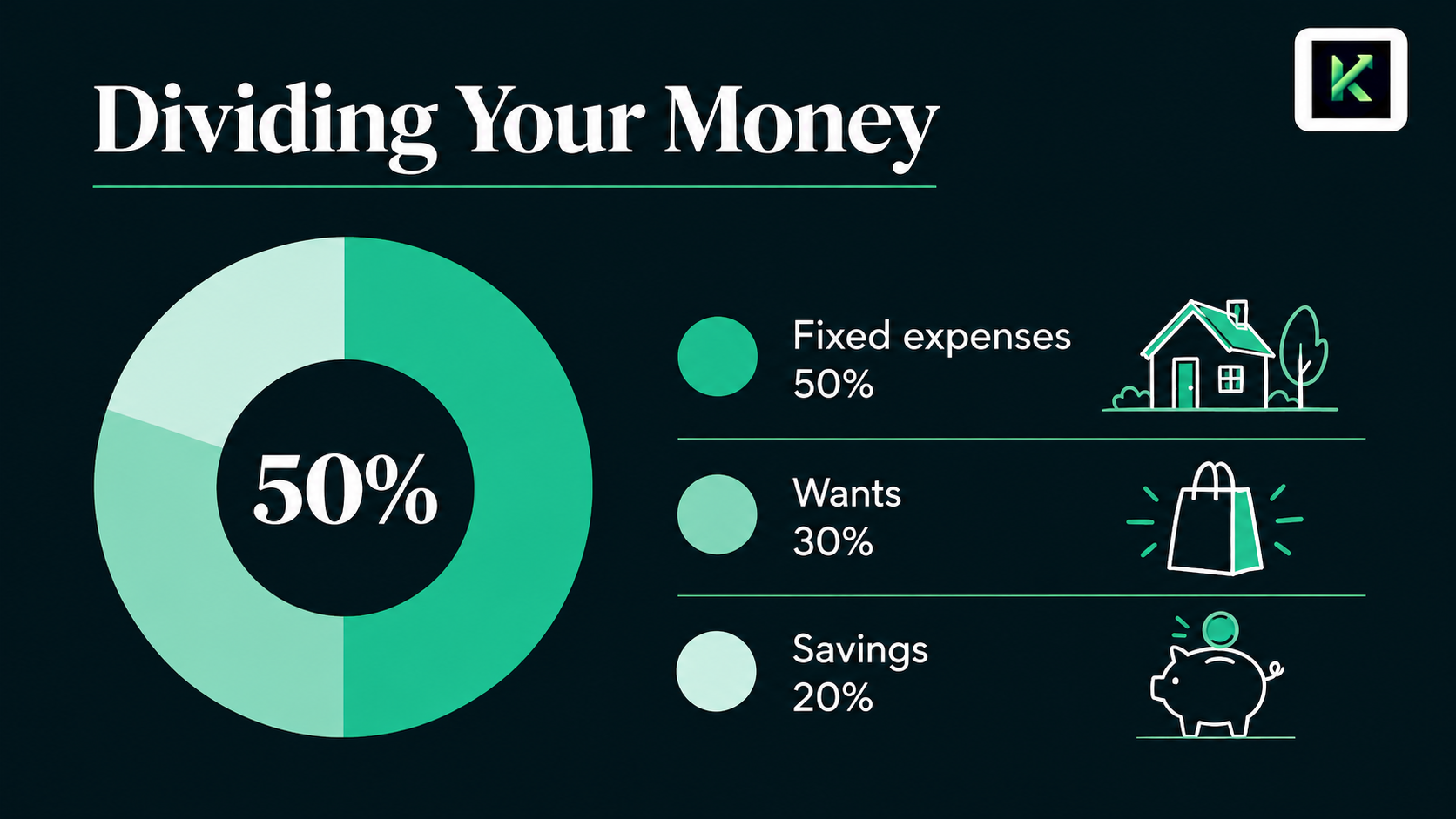
Once you know what comes in and what is committed to fixed costs, the next question is how to divide it up. A tried-and-tested starting point is the 50/30/20 rule: 50% of income for fixed expenses such as rent, electricity and insurance, 30% for leisure, wants and hobbies, and 20% for savings goals or unexpected expenses.
Illustrative calculation with €2,800 in take-home income:
| Category | Share | Amount |
|---|---|---|
| Fixed expenses | 50% | €1,400 |
| Wants and leisure | 30% | €840 |
| Savings and buffers | 20% | €560 |
In expensive cities such as Munich or Hamburg, rent alone often takes more than half. In that case, adjust the proportions—for example, to 60/25/15—while keeping the same priorities: essentials first, then savings buffers, then wants. Hamburg’s consumer advice center recommends prioritizing expenses by urgency. Money for rent, electricity, water, food and maintenance payments must always come first. Work out your own allocation in seconds with our free 50/30/20 budget calculator.
Planning savings buffers and goals
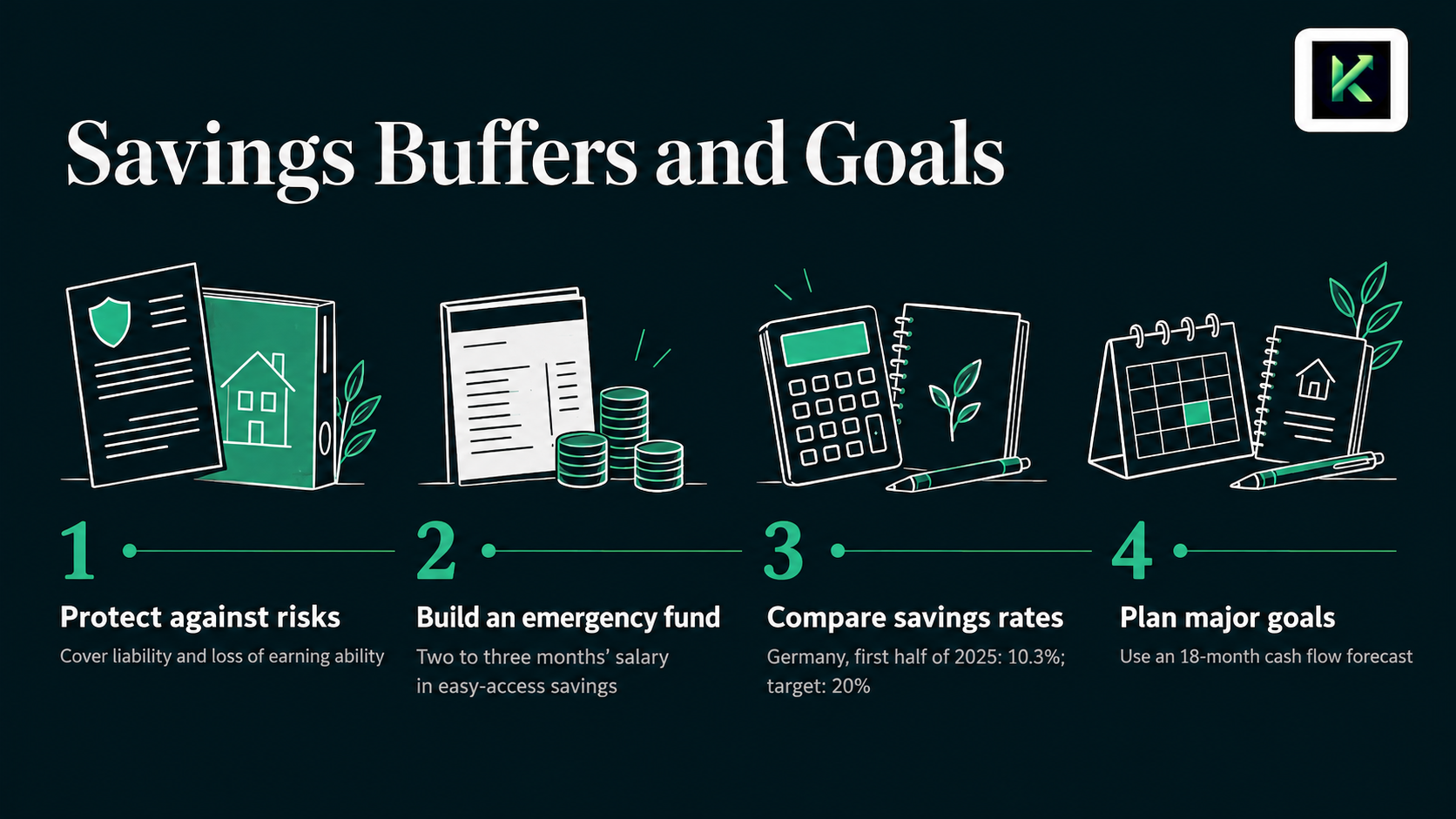
Organized finances hold up even when the washing machine breaks down. The consumer advice service suggests a rule of thumb of two to three months’ salary as an emergency fund, kept in an easy-access savings account where the money is available every day. If you have children or a fluctuating income, consider allowing more.
For context, Germany’s Federal Statistical Office reports that private households in Germany saved a seasonally adjusted 10.3% of their income in the first half of 2025. The 20% in the 50/30/20 rule is therefore an ambitious goal, though it may be achievable depending on your circumstances.
The order matters. In its background information on financial planning, the consumer advice service sets out the principle: protect against risks first, then save. This means major financial risks such as liability claims or losing your ability to work, addressed in Germany through products such as personal liability insurance and occupational disability insurance. An independent consumer advice service can help you establish what protection you need in your circumstances and country.
Then come the big goals: a vacation, a car, parental leave or buying an apartment. Here, looking ahead helps more than looking back. A cash flow forecast helps you assess whether your balance in 18 months will cover a down payment, or whether parental leave could create a shortfall. Our guides to parental leave in your household budget and planning your deposit for an apartment purchase show what this looks like in practice.
Organizing finances as a couple or family
As soon as two people share an account, rent or responsibility for children, they need a shared set of figures. North Rhine-Westphalia’s family information portal recommends taking stock as the starting point for a conversation about money: all accounts, savings contracts and investment accounts, loans and repayment schedules, overdrafts, monthly income from salary to child benefit, and monthly costs from rent to childcare.
Three questions to work through together:
- Which setup suits us? One joint account for everything, separate accounts with a shared household fund, or a mix. What matters is that you both see the same figures.
- Who pays for what? Many couples find splitting fixed costs in proportion to income fairer than splitting them equally.
- Where do we want to go? Shared goals, such as having a child or buying a home, need a shared plan with a target date and amount.
The usual sticking point: one person maintains the spreadsheet and the other never sees it. KRONO addresses this with optional private iCloud household sharing. You can share your household through your private iCloud; enabling this option means using Apple’s iCloud service rather than keeping everything exclusively on your device. Read more in our guide to a budgeting app for couples and families.
Paper, spreadsheet or app: what works long term?
The consumer advice service is clear: the tool is not the deciding factor; getting started is. To help you stick with it, choose a tool that fits your everyday life.
| Criterion | Finance app (KRONO) | Spreadsheet | Paper |
|---|---|---|---|
| Recording on the go | Directly on your iPhone; KRONO is iPhone-only | On a computer | Collect receipts and enter them later |
| Accounts, debts and net worth | In one place | Build it yourself | Difficult to manage |
| Forecasting | Up to 24 months | Write your own formulas | No |
| Shared use | Optional private iCloud household sharing | Share the file | One notebook for everyone |
| Analysis | Financial score, trends and PDF report | Create your own charts | By hand |
If you enjoy working with spreadsheets, our Budgeting: app or Excel? comparison provides a detailed side-by-side look. And our Budget app vs. bank app comparison explains why the overview in your bank’s app is not the same thing.
Your finances in one place with KRONO
KRONO is a private, iPhone-only finance app that brings together your budget, accounts, debts, net worth and cash flow. KRONO Free gives you an overview with up to 3 accounts, 2 loans and 1 monthly budget, free forever and without a subscription, even without bank access. Your data is stored locally on your device, with optional syncing and household sharing through your private iCloud.

KRONO Pro unlocks unlimited accounts and loans, cash flow forecasts and advanced planning tools, including Monte Carlo simulations for life events such as having a child, buying property or retiring. Optional bank connections are available only in Germany via Salt Edge; in other countries, use manual entry or CSV import. In Germany, Pro costs €6.99 per month or €69.99 per year through the App Store; elsewhere, prices vary by region. Compare all plans.
Our view: getting organized means looking ahead
Most people who want to organize their finances start with a spending log. That is the right approach, because you need honest figures. But a spending log only answers the question of where your money went.
Real peace of mind comes when you have a clearer idea of where your money will go. That is why we built KRONO to bring your budget, debts, net worth and a forecast for up to 24 months together on one screen. Our financial score combines seven factors into one number, so you do not have to interpret every metric individually.
And because money is deeply personal, your data is stored locally on your iPhone. You can choose to share it with your partner through your private iCloud. The basic version is free forever, with up to 3 accounts, 2 loans and 1 monthly budget, because financial clarity should not depend on a subscription.
Thomas
Frequently asked questions
What should a financial plan include?
A complete financial plan includes your income, fixed and variable expenses, all accounts and debts, your savings buffers, and your goals with target amounts and dates. It also looks ahead: how will your account balance develop over the coming months? KRONO brings these elements together in one place.
How often should I review my finances?
The consumer advice service recommends entering receipts once a week and reviewing your finances once a month. It is also worth reviewing contracts, insurance and savings goals once a year. In Germany, optional automatic bank imports in KRONO Pro via Salt Edge can replace weekly manual transaction entry. In other countries, use manual entry or CSV import.
Do I need a bank connection to organize my finances?
No. You can organize your finances in KRONO Free using manual entry, within its limits of 3 accounts, 2 loans and 1 monthly budget. The optional bank connection in KRONO Pro saves time by importing transactions automatically, but is available only in Germany via Salt Edge. Elsewhere, use manual entry or CSV import. Our guide to a budgeting app without bank access explains how this works.
How much should I save each month?
The 50/30/20 rule suggests 20% of take-home income as a guideline. First, build an emergency fund of two to three months’ salary in an easy-access savings account, then save for larger goals. If 20% is not yet realistic, start with a smaller fixed amount as soon as your pay arrives.
Sources
- German consumer advice service: Keeping a household spending log to understand your finances
- Rhineland-Palatinate consumer advice center: My household budget book (PDF)
- Bremen consumer advice center: Household budget planner (PDF)
- Hamburg consumer advice center: Household budget
- German consumer advice service: Emergency funds and easy-access savings
- German consumer advice service: Background information on financial planning (PDF)
- German national debt advice association: Household budget
- Finanztip: Plan your household budget in 7 steps
- German Federal Statistical Office: Savings rate in the first half of 2025
- North Rhine-Westphalia family portal: Talking about money