
Managing Expenses: How to Stay in Control of Your Money
Managing your expenses well comes down to three things. Record each expense promptly. Assign it to one of a few clear categories. And once a month, compare what you spent with what you planned to spend. The tool you choose matters less than using it consistently. Here, we walk you through getting started, categorizing tricky expenses, turning your figures into a budget, and keeping track of shared spending as a couple or family.
krono.info
Keep track of your spending
KRONO brings budgeting, accounts and cash flow together in one place, helping you track income and expenses accurately.
Discover KRONOAt a glance
- Record expenses promptly: Note the date, amount and category, including card payments. Catch up on any missing entries at least once a week.
- Keep categories simple: Separate fixed costs from variable expenses and start with broad areas such as housing, groceries, transport and leisure.
- Break down annual costs: Divide insurance premiums or vehicle tax by twelve and set that amount aside each month.
- Review each month: Subtract your variable expenses from your available budget. Put anything left over into savings. If you fall short, identify the category that needs adjusting.
- Plan together: Couples and families need a shared overview that clearly separates personal and joint expenses.
Contents
- Why a clear overview pays off
- Tracking expenses: consistency counts
- Categorizing expenses: keep it clear
- From tracking to budgeting
- Monthly review: when the budget doesn't balance
- Managing expenses together as a couple or family
- Paper, spreadsheet or app: what works for you
- Managing your expenses with KRONO
- Our view: managing expenses means looking ahead
- Frequently asked questions
- Sources
Why a clear overview pays off
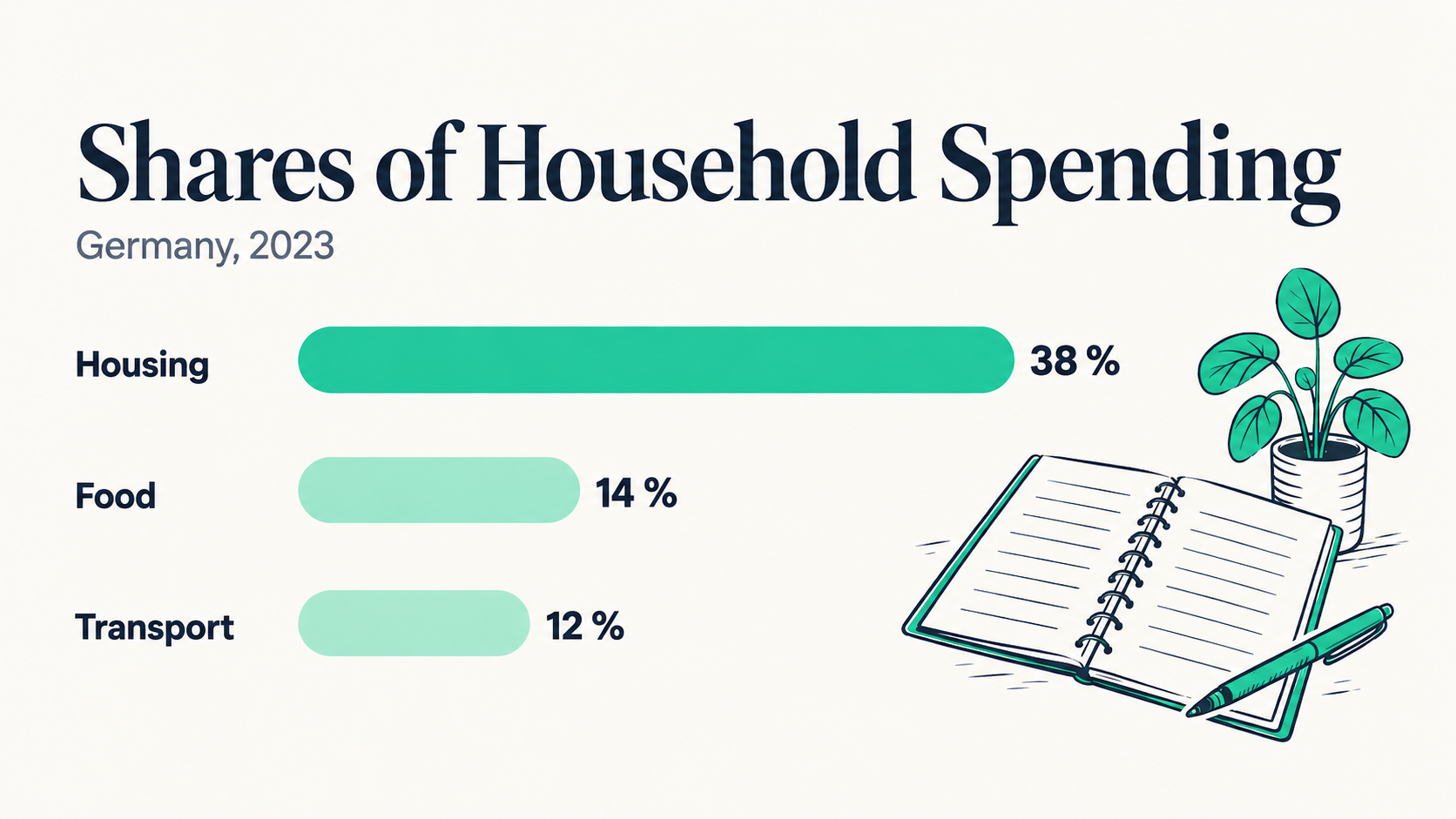
Most people have a good idea of what their rent costs. But they don't know where the rest of their money goes. The biggest bills aren't necessarily the problem. According to the German Federal Statistical Office's 2023 Sample Survey of Income and Expenditure, an average household in Germany spent €3,030 a month on private consumption. Housing accounted for 38%, food for 14% and transport for 12%. For households with an income below €1,300, housing and food alone accounted for almost two-thirds of spending.
What does that mean for you? If you have little room to maneuver, you need to know exactly what your other expenses are. Higher earners, meanwhile, spend a greater proportion on leisure, transport and clothing. Without a clear overview, those are precisely the areas where money can quietly slip away. A well-kept spending ledger reveals patterns, habits and the things driving your costs. Instead of wondering where your money went at the end of the month, you decide what it is for.
Tracking expenses: consistency counts
The first step is the least glamorous: write everything down. Germany's consumer advice service, Verbraucherzentrale, recommends a simple routine. Collect receipts, jot down small purchases and enter everything into your budget planner once a week.
For your entries to be useful later, each needs three pieces of information. The Hessen VerbraucherFenster consumer information portal lists them as follows:
- Date: When did you spend the money?
- Amount: How much was it, down to the last cent?
- Category: What was it for? Groceries or clothing, for example.
Card payments are the most common source of missed entries. A coffee at the station, a quick phone payment, an online subscription: none of these leaves a visible gap in your wallet, so they're easy to overlook when catching up. That's why you should compare your notes with your bank statement once a week.
Find a routine that works for you
- Immediately after a purchase: The most accurate option, because you don't forget anything. With your iPhone in hand, an entry takes only a few seconds.
- Every evening: For many people, this is the most realistic approach. Five minutes before bed is enough.
- Once a week: The minimum recommended by Verbraucherzentrale. Keeping receipts is essential if you choose this approach; otherwise, purchases will go missing.
If you don't want to type in transactions by hand, an automatic import can help. In KRONO, an optional Open Banking connection through Salt Edge is available only in Germany with Pro, bringing bank transactions directly into the app. If you prefer not to authorize access to your bank account—or live outside Germany—you can import a CSV file or enter expenses manually. We explain how in our guide to a budget app without bank access.
Categorizing expenses: keep it clear
Categories turn a long list of amounts into something meaningful. They let you see, for example, that you spent €140 on food delivery in October, rather than just making “lots of small payments.” This is an illustrative example.
First, separate fixed and variable costs
The most important distinction comes before any detailed categories:
- Fixed expenses recur regularly at the same amount. They include rent, monthly energy payments, phone contracts, transport passes such as Germany's Deutschlandticket, and membership fees.
- Variable expenses change from month to month. They include groceries, restaurant meals, clothing, repairs, travel and one-off purchases.
This distinction has a practical purpose. Reducing fixed costs usually means changing contracts, something you do infrequently and with some effort. Variable spending, on the other hand, can be adjusted every week.
Then sort spending into a few broad categories
DHB Hessen recommends starting with broad categories. It suggests housing, food, transport, health, leisure, reserves and savings goals. These provide a practical starting framework:
| Category | Typical expenses | Mostly fixed or variable? |
|---|---|---|
| Housing | Rent, service charges, electricity, internet | Fixed |
| Groceries and household essentials | Supermarket, bakery, toiletries and household supplies | Variable |
| Transport | Deutschlandticket transport pass, fuel, car insurance, servicing and repairs | Mixed |
| Health | Co-payments, pharmacy purchases, glasses, gym membership | Mixed |
| Leisure | Restaurants, cinema, hobbies, streaming, vacations | Variable |
| Contracts and insurance | Personal liability insurance, home contents insurance, phone, subscriptions | Fixed |
| Reserves and savings goals | Emergency fund, vacation fund, retirement savings | Fixed, if paid by standing order |
Seven to ten categories are enough to get started. If you begin with thirty subcategories, you'll spend more time sorting than saving. You can always add detail later if one category becomes noticeably large. For example, if “Leisure” consistently accounts for your largest variable expense, separate out “Eating out.”
How to categorize tricky expenses
In everyday life, plenty of purchases don't fit neatly into one box. These rules will help keep your analysis consistent:
- Mixed purchases: Does a receipt include shampoo, diapers and a gift? For a general overview, it's enough to assign the receipt to the category accounting for most of the total. Split it only if one item makes a significant difference.
- Irregular expenses: The washing machine breaks down, or the dentist sends a bill. These belong in their usual categories, not “Miscellaneous.” Otherwise, “Miscellaneous” becomes your biggest category and tells you nothing useful.
- Expenses spanning several areas: Car costs belong under transport, even when you drive on vacation. Decide once how to handle each gray area and stick to it. That's the only way to compare months meaningfully.
- Refunds: If money comes back, whether from a health insurer or a returned purchase, record it in the same category as the original expense. This keeps the category accurate.
From tracking to budgeting
After tracking your expenses for one or two months, you'll know where your money goes. Now turn your attention forward and decide in advance how much each area can receive.
Step 1: Work out your fixed costs
List all regular expenses: rent, energy, phone, membership fees, insurance and loan repayments. Verbraucherzentrale recommends converting expenses that arise only once or twice a year into monthly amounts and setting that money aside. Insurance premiums and vehicle tax are examples.
Here's an illustrative example using German expenses: personal liability insurance costs €120 a year, so you set aside €10 each month. Car insurance costs €540 a year, which works out to €45 a month. Germany's broadcasting contribution, paid quarterly in this example, is also included on a proportional monthly basis. When the bill arrives, the money is already there, so it doesn't throw your monthly budget off balance.
Step 2: Calculate your available budget
The formula is simple: Net income minus fixed costs, including the monthly share of annual costs, equals your budget for variable expenses. Divide that amount among your variable categories. Use the figures from your first months of tracking as a guide. If you prefer a rule of thumb, our 50/30/20 budget calculator can give you an initial breakdown into needs, wants and savings.
Step 3: Prioritize your expenses
Verbraucherzentrale Hamburg suggests dividing expenses into three groups: essential, nice to have and unnecessary. This also means regularly reviewing contracts, memberships and subscriptions. It pays off particularly well with fixed costs. Canceling a subscription saves money every month without requiring any further effort.
Monthly review: when the budget doesn't balance
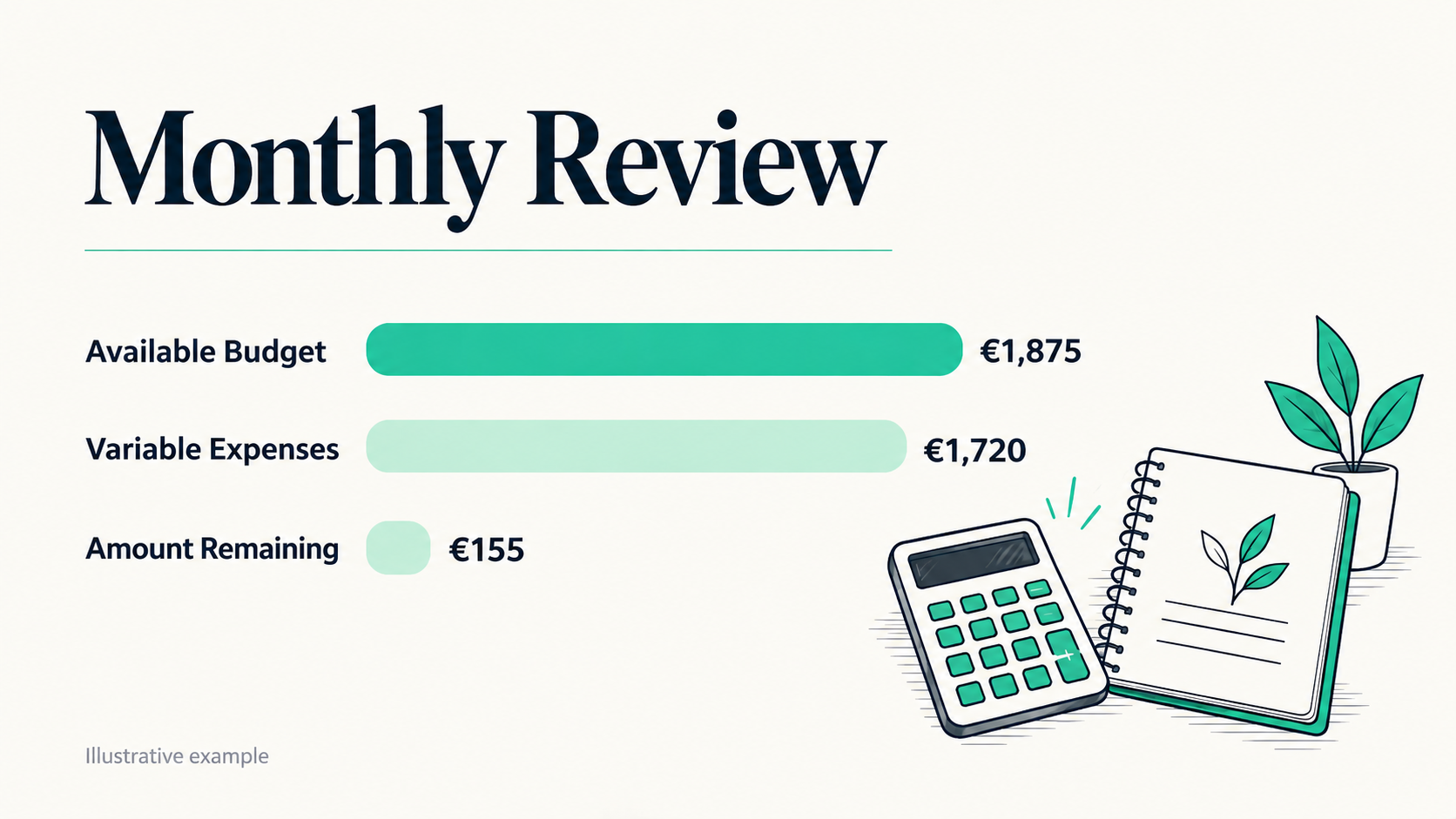
Review your finances once a month. Verbraucherzentrale describes the process like this: add up your variable expenses and subtract them from your available budget. In its illustrative example, a budget of €1,875 and expenses of €1,720 leave €155. That surplus can go straight into your reserves.
If the result is negative, don't look for someone to blame—look for the category. Hessen VerbraucherFenster recommends taking another close look at all spending, reconsidering memberships and canceling unnecessary contracts. One example is replacing expensive meals out with home-cooked food.
Here's how to deal with differences between your plan and actual spending:
- One-off expense or a pattern? A car repair is a one-off expense. Overspending on food delivery for three months in a row is a pattern.
- Cover one-off expenses from your reserves and consider whether a dedicated fund would make sense in future—for example, an illustrative €30 a month for repairs.
- Address patterns in your budget: Either make the budget more realistic and cut back elsewhere, or change the habit.
- Change just one thing each month. Trying to overhaul everything at once rarely lasts.
Planning beyond the current month helps you spot shortfalls earlier. A 24-month cash flow forecast can show you, for example, which month brings an insurance bill, a vacation and a loan repayment together.
Managing expenses together as a couple or family
As soon as two or more people share household finances, another question comes up: what is shared, and what belongs to each person individually? A simple division has proved useful:
- Shared expenses: Rent, groceries, electricity, household insurance, childcare and vacations together.
- Personal expenses: Hobbies, clothing, gifts for each other and individual subscriptions.
Many couples pay joint expenses from a shared account into which both transfer a fixed amount. Each person keeps the rest of their money separate. Whether you contribute equally or in proportion to your incomes is up to you. What matters is agreeing on the rule once, rather than renegotiating every purchase.
For this to work, you need a shared view of the numbers. Both of you should be able to see how much is left in the grocery budget without sending screenshots back and forth. Expenses can change significantly around parental leave, the start of childcare or a move. Planning that accounts for these life events can make a huge difference. Find out more in our guide to household budgeting for couples and families and our guide to planning your household budget during parental leave.
Paper, spreadsheet or app: what works for you
Verbraucherzentrale Hamburg explicitly recommends keeping a household spending ledger or using a comparable app. Some digital budget planners can connect directly to your bank account. Here's how the three approaches compare in everyday use; app features depend on the product and region.
| Criterion | Paper spending ledger | Spreadsheet | Finance app on iPhone |
|---|---|---|---|
| Recording expenses on the go | Keep receipts and enter them later | Often done later at a computer | Immediately, in seconds |
| Categories and analysis | Calculate by hand | Create your own formulas | Automatic, with charts and trends |
| Card payments | Reconcile manually | Organize CSV exports yourself | Import through a bank connection or CSV; KRONO's optional bank connection is Germany-only |
| Shared use | One book for everyone | Shared file, which can become hard to navigate | Shared household with an individual view; KRONO offers optional private iCloud sharing |
| Planning beyond the current month | Difficult | Time-consuming | Built-in forecasts and scenarios where supported |
It's worth taking a close look at privacy. Your bank transactions reveal a lot about you: where you shop, where you live and what you spend money on. Check where an app stores this information and who can access it. Our guide to financial planning without the cloud explains how planning with locally stored data works.
Managing your expenses with KRONO
KRONO is a private finance app available only for iPhone. It brings the practices covered in this guide together in one place: recording and categorizing expenses, planning a budget and reviewing the month. It also covers accounts, debt, net worth and cash flow. Your data is stored locally on your device. Couples and families can optionally share their household privately through iCloud.
KRONO Free is free forever for up to 3 accounts, 2 loans and 1 monthly budget, with manual entry or CSV imports. KRONO Pro expands the feature set, including unlimited accounts and loans, optional automatic bank connection through Salt Edge in Germany only, monthly financial reports as PDFs and advanced planning tools such as Monte Carlo simulation. Outside Germany, use manual entry or CSV imports. In Germany, Pro costs €6.99 a month or €69.99 a year; prices elsewhere vary by region. You'll find all the details on our pricing page.
Our view: managing expenses means looking ahead
Most spending ledgers look backward. They tell you what happened last month. That's the starting point, not the goal. We built KRONO because we believe that staying truly in control of your expenses also means seeing what's coming: the insurance bill in March, the loan repayment, a child next year, a home in five years.
That's why KRONO combines everyday expense tracking with a cash flow forecast covering up to 24 months and planning for life events. Our financial score assesses your situation using seven factors. You can see where you stand at a glance, rather than working your way through spreadsheets.
Trust matters just as much to us. Your financial data belongs to you. That's why KRONO stores it locally on your iPhone, with optional household sharing through your private iCloud. The basic version stays free forever for up to 3 accounts, 2 loans and 1 monthly budget, so nobody has to take out a subscription just to get a clear view of their expenses. If you want more, such as deeper planning or optional bank imports in Germany through Salt Edge, you can upgrade to Pro.
Thomas
Frequently asked questions
How many expense categories do I need?
Seven to ten broad categories are enough to start with—for example, housing, groceries, transport, health, leisure, contracts and reserves. Split a category only when it consistently accounts for a large amount and you want to understand what's behind it. Too many categories make recording expenses tedious and analyzing them confusing.
How long should I track expenses before creating a budget?
Two to three months give you a realistic picture because unusual expenses start to average out. But you can create a provisional budget after the first month and adjust it afterward. Convert annual costs, such as insurance, into monthly amounts from the start.
How should I handle cash withdrawals?
A cash withdrawal isn't an expense yet—it's simply a transfer from your bank account to your wallet. Record individual cash purchases in their relevant categories instead. If you can't always do that, at least record any untracked cash spending at the end of the month under the category you most often use cash for.
Can I manage my expenses without connecting my bank?
Yes. With KRONO Free, you can enter expenses manually or import bank transactions as a CSV file, without granting access to your bank account. Optional automatic bank connection through Salt Edge is part of KRONO Pro in Germany only and saves you typing if you prefer that convenience. In other countries, use manual entry or CSV imports.
How often should couples discuss shared expenses?
A regular monthly check-in is usually enough, timed to coincide with your monthly review. Look together at where you're on track and decide what to do with any surplus. Between check-ins, a shared app overview helps you both see the same up-to-date picture.
Sources
- German Federal Statistical Office: Cost of living in 2023, press release no. 438
- Verbraucherzentrale: Keeping a household spending ledger
- Hessen VerbraucherFenster: Household budgeting in five steps
- Verbraucherzentrale Hamburg: Household budgets
- DHB Hessen: Organizing household finances effectively