
Making Homeownership Affordable: How to Plan Your Budget and Down Payment

The asking price in a property listing does not tell you whether you can afford it. Your cash flow does—and it needs to hold up for many years. How much is left each month after all your expenses? How much of your own money can you actually contribute? What happens if you have a child, lose one income or need to repair the roof? Buying a home becomes a realistic prospect when you know these numbers before you speak to a bank. That is exactly why we built KRONO: income, expenses, accounts, debts and net worth in one place, plus a cash flow forecast looking up to 24 months ahead. This guide takes you step by step from your household budget to a realistic purchase price, with a worked example of a family's finances.
The lending guidelines, taxes and purchase costs discussed here refer to Germany. They are not universal rules: requirements and costs vary by country and lender. All illustrative amounts remain in euros.
At a glance
- Start with an honest household budget: income minus all expenses, including irregular ones, gives you your surplus. Use that to work out an affordable mortgage payment—not the other way around.
- Leave around 10 percent of your surplus as breathing room rather than committing it to the loan payment. Many German banks recommend limiting payments to no more than 40 percent of net income.
- Allow for purchase costs of up to 10 percent of the purchase price in the German planning framework used here. Banks often require buyers to contribute 20 percent of total costs from their own funds.
- Retirement savings, children and home maintenance reserves belong in the calculation from the start. Otherwise, the payment is affordable only on paper.
- A finance app with forecasting helps you assess whether your plan still works in 12 or 24 months and how much longer you need to save for your upfront contribution.
Contents
- Is buying a home still affordable today?
- Step 1: Work out your actual surplus
- Step 2: Turn your monthly payment into a potential loan amount
- Step 3: Allow for purchase costs and your own contribution
- Step 4: Build your down payment with a clear savings plan
- Step 5: Do not underestimate ongoing costs and financial buffers
- Step 6: Account for life events from the start
- The key figures at a glance
- Take your own figures to the bank
- Our view: Affordability starts with a clear financial picture
- Frequently asked questions about buying a home
- Sources
Is buying a home still affordable today?
The honest answer is that it has become harder for many households, but not impossible. The German Economic Institute's 2026 Affordability Index concludes that homeownership remains difficult for many households to achieve because of the relationship between purchase prices, financing costs and household incomes.
A sample of properties in Stuttgart and Esslingen examined by SWR shows how wide the range can be: depending on the property and location, prices ranged from just under €400,000 to well over €700,000. Prices in rural areas are often considerably lower, while those in major cities can be higher still.
That leads to the most important point in this article: the question is not whether people in general can afford a home, but which home fits your household's finances. No statistic can answer that—only your own calculations can. And those calculations start with your bank account, not your dream property.
Step 1: Work out your actual surplus
The German consumer advice service Verbraucherzentrale recommends starting with a household budget: compare income and expenses, account for future changes and calculate your expected surplus. It sounds simple. In practice, three things tend to go wrong.
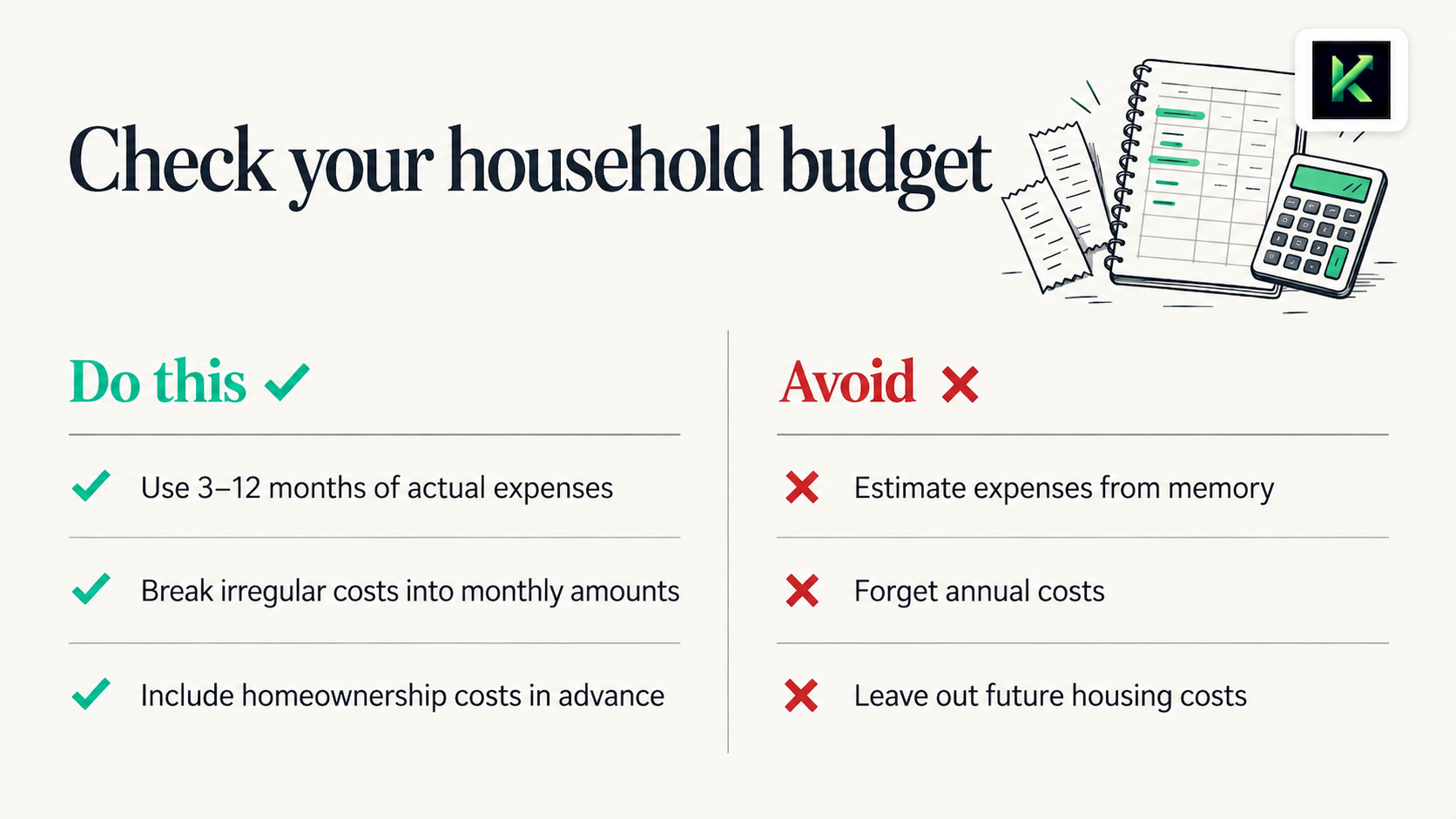
First: using estimated rather than actual expenses. If you write down your expenses from memory, you will almost always underestimate them. Groceries, fuel, subscriptions and impulse purchases add up to more than you think. It is better to use actual figures from at least three months, ideally six to twelve.
Second: forgetting irregular costs. Car insurance, holidays, gifts, repairs and annual fees all count. Verbraucherzentrale explicitly recommends including these irregular costs and budgeting conservatively. Break them down into monthly amounts: for example, €1,200 a year for holidays is €100 a month.
Third: overlooking costs you do not have yet. As a homeowner, you will face expenses you may not pay directly as a tenant: property tax, buildings insurance, maintenance and potentially higher energy costs. At the same time, you will no longer pay basic rent. Include this shift in the calculation before deciding on a mortgage payment.
This is where a finance app comes into its own. In KRONO, you can record income and expenses manually or import them by CSV. In Germany only, KRONO Pro also offers an optional bank connection through Salt Edge to bring transactions into your household records automatically; in other countries, use manual entry or CSV. After a few months, trend-based analyses show where your money actually goes, rather than leaving you to work with estimates. If you are buying as a couple, you can optionally share your household through private iCloud household sharing so you both work from the same figures. Our worked budget example for €2,500 in monthly take-home pay shows what a monthly budget like this can look like.
Step 2: Turn your monthly payment into a potential loan amount
Use your surplus to work out your mortgage payment. According to Verbraucherzentrale, you should leave around 10 percent as breathing room between your surplus and your payment, and many banks recommend limiting the payment to no more than 40 percent of net income. Your monthly payment, interest rate and initial principal repayment rate then determine the potential loan amount.
The formula for a rough calculation is:
Loan amount = annual payments ÷ (interest rate + initial annual principal repayment rate)
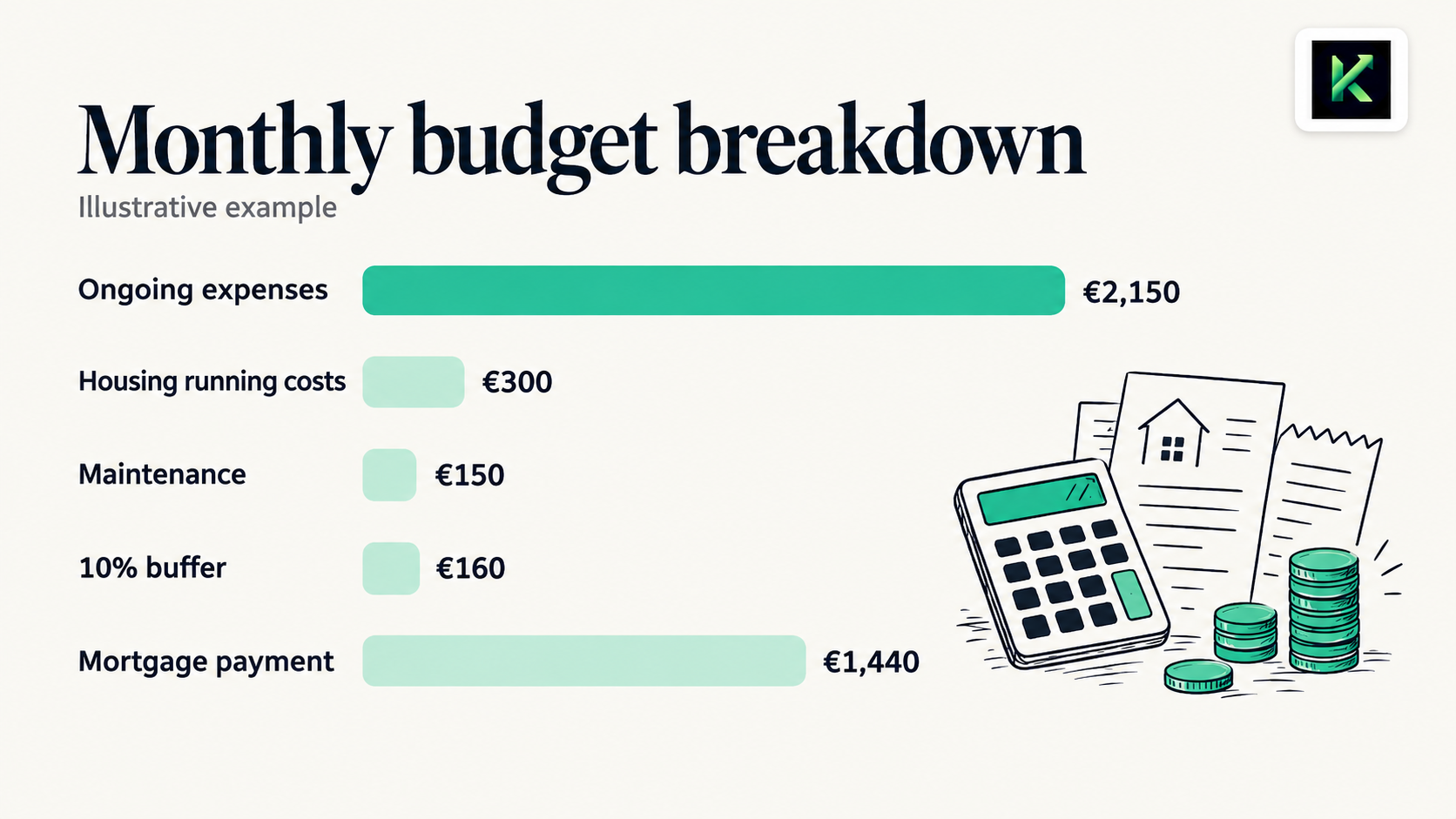
Example: A family with €4,200 in monthly take-home income
Let us take a family with a net household income of €4,200 a month. These figures are illustrative; your own will be different:
| Item | Monthly amount |
|---|---|
| Net household income | €4,200 |
| Ongoing expenses excluding rent, including irregular costs | €2,150 |
| Future housing running costs as homeowners | €300 |
| Maintenance reserve | €150 |
| Surplus | €1,600 |
| Less around 10% breathing room | €160 |
| Affordable mortgage payment | €1,440 |
For comparison, 40 percent of €4,200 would be €1,680. Here, the household budget sets a stricter limit than the rule of thumb—and that is exactly the point. The rule of thumb does not know your expenses; your household budget does.
Assuming a combination of 3.5% nominal interest and a 2% initial annual principal repayment rate, the calculation is €1,440 × 12 = €17,280 in annual payments. Dividing that by 5.5% gives a potential loan amount of around €314,000. For your own calculation, use the interest rate you are currently being offered, because even a one-percentage-point difference changes the result considerably. This is a rough calculation using a German-style repayment structure, not a universal mortgage quote.
We explain how payments affect your remaining debt over the years in our guide to mortgage payments and outstanding balances.
Step 3: Allow for purchase costs and your own contribution
The purchase price is not the total amount you pay. In Germany, property transfer tax, notary fees, land registry fees and, where applicable, estate agent commission come on top. According to Verbraucherzentrale, these additional purchase costs can amount to 10 percent of the purchase price. Each German federal state sets its own property transfer tax rate, so check the current rate in the state where you are buying. Outside Germany, check the applicable local taxes and fees.
According to the same source, banks often require buyers to contribute 20 percent of total costs from their own funds. Buyers who put in little or none of their own money pay higher interest rates and tend to take longer to repay the property loan. You should therefore aim to cover at least the additional purchase costs yourself.
Continuing the example
Our illustrative family has €90,000 of its own funds available. Combined with the loan, that gives a total budget of around €404,000. Allowing 10 percent for purchase costs leaves a purchase price of approximately €367,000 (€404,000 ÷ 1.1). The family's €90,000 contribution represents just over 22 percent of total costs, so it meets the usual 20-percent benchmark.
That is the figure the family takes into its property search: around €367,000, not the amount an online calculator produces using the maximum possible monthly payment. Anyone looking in an expensive area can immediately see which levers are available: a larger personal contribution, a smaller property, a different location or buying later.
Step 4: Build your down payment with a clear savings plan
If you do not yet have enough of your own funds, saving is the most effective lever: every euro saved reduces the loan amount and the interest you pay. Before doing the calculations, check what can already count toward your contribution. According to Verbraucherzentrale, savings contracts intended for retirement, such as pension insurance and endowment life insurance policies, as well as other investments, can also form part of your own funds. It can often make sense to cash in savings contracts and use the proceeds to reduce the loan. Whether that is appropriate for your contract is best discussed with an independent consumer adviser, because surrendering a policy or closing a contract can lead to losses or tax consequences.
Next, calculate your savings gap:
- Set a target. Aim for 20 percent of the planned total costs, or at least enough to cover the additional purchase costs.
- List what you already have. Easy-access savings, investment portfolios, home savings contracts and other savings arrangements. A net worth overview lets you see everything at a glance.
- Calculate the gap. Subtract your existing funds from your target.
- Set a monthly savings amount. Divide the gap by your monthly savings to find the number of months needed to reach your goal.
For example, suppose your target is €90,000 and you already have €50,000. At €900 a month, you need a little over 44 months—just under four years. At €1,200 a month, it would take around 33 months.
A tried-and-tested approach is to start saving the difference between your planned mortgage payment and the rent you currently pay, including housing charges. If you can keep that up for several months without running short, you have passed a practical stress test for the future payment while building your down payment at the same time. If you cannot, you find out before signing the purchase documents.
The 50/30/20 budget calculator helps you identify room to save more. Our guide to buying an apartment: planning your down payment and budget explains how to map out the purchase and your savings target in detail.
Step 5: Do not underestimate ongoing costs and financial buffers
Your mortgage payment is not your only financial commitment. Verbraucherzentrale recommends allowing buffers for repairs, energy, taxes and insurance, and keeping the payment in view throughout the loan term. A heating system, roof or replacement windows may not need attention on your preferred schedule, but sooner or later they will.
In practice, that means:
- A dedicated maintenance reserve as a monthly budget item, not a vague intention.
- An emergency fund left over after the purchase. If you put all your savings into buying the property, the first repair can become a problem.
- A plan for when your fixed-interest period ends. The Association of German Banks emphasizes that homeownership is a long-term commitment requiring forward-looking financial planning so you can continue to make payments in the future.
Repaying principal faster shortens the loan term and reduces interest costs, but increases the monthly payment. Check whether your surplus will still be enough when unexpected expenses arise.
Step 6: Account for life events from the start
The biggest threat to affordability is not necessarily interest rates—it is life. Having a child, taking parental leave, changing jobs or moving to part-time work can each alter income and expenses for years.
In Tagesspiegel, financial analyst Volker Looman presents a calculation in which a family with €150,000 of its own funds can finance a purchase price of around €739,000 at an interest rate of 4.25%—but only if other commitments, such as retirement provision and children's education costs, are covered. He warns against making the family home your only wealth-building goal, because you could otherwise be forced to sell it in retirement.
For your planning, that means:
- Keep saving for retirement. Contributions to your personal retirement savings should be a fixed item in your household budget before you set the mortgage payment.
- Plan for children. Calculate how parental leave and the costs of raising children would affect your surplus. Our guide to parental leave and your household budget shows you how.
- Compare scenarios. What happens if one income falls for a year? Is your buffer enough?
This is exactly where a forecast is more useful than a one-off calculation. In KRONO, you can add life events such as buying a property, having a child or retiring and see how they change your cash flow. KRONO Pro adds planning tools such as the Monte Carlo simulation in Life Plan, which explores many possible outcomes rather than just one.
The key figures at a glance
| Measure | Guideline | What it means |
|---|---|---|
| Breathing room between surplus and payment | Around 10% | A monthly buffer for unexpected expenses |
| Mortgage payment as a share of net income | No more than 40% | An upper limit recommended by many German banks |
| Additional purchase costs | Up to 10% of the purchase price in this planning framework | Tax, notary, land registry and estate agent fees |
| Your own contribution | Often 20% of total costs | Better interest rates and a faster route to being debt-free |
| Reserves after the purchase | A separate monthly budget item | Maintenance savings and an emergency fund |
All these guidelines come from Verbraucherzentrale's guides and refer to the German context. They offer guidance, not a guarantee: what matters is that your own figures meet the relevant requirements, including in your forecast for the coming years. Check actual purchase costs and lending criteria locally rather than treating these percentages as universal limits.
Take your own figures to the bank
Verbraucherzentrale recommends approaching financing offers with healthy skepticism, because banks and building societies have an interest in earning interest and commissions. The best preparation is your own robust calculation. If you know which monthly payment your household can afford, you can negotiate the terms rather than your budget.
With KRONO, you always have those calculations with you. KRONO is available only for iPhone. KRONO Free is free forever for up to 3 accounts, 2 loans and 1 monthly budget, giving you an overview of your budget, accounts, debts and net worth without a subscription. KRONO Pro costs €6.99 a month or €69.99 a year in Germany; prices elsewhere vary by region. Pro adds unlimited accounts and loans and advanced planning tools. An optional bank connection through Salt Edge is available only in Germany; elsewhere, use manual entry or CSV. Features remain subject to regional and device requirements. Optional AI is Pro-only, off by default and requires a compatible iPhone with Apple Intelligence; it runs on-device, and actions require your confirmation.
Your financial records are stored locally on your iPhone, with optional syncing through your private iCloud. If you choose the optional German bank connection, Salt Edge is involved in providing that connection. You can print monthly financial reports as PDFs or take them to your bank meeting. A comparison of the plans is available on the KRONO Free and Pro page.
Our view: Affordability starts with a clear financial picture
When we talk about buying a home, the conversation almost always revolves around interest rates and purchase prices. You have little control over either. What you can control is how well you understand your own finances.
Many households calculate affordability once, usually with an online calculator shortly before meeting a bank, and then rely on that single number. But buying a home is not a single moment—it is a commitment lasting decades. That is why we built KRONO to bring your budget, accounts, debts, net worth and cash flow together in one place, with a view up to 24 months ahead.
Our Financial Score assesses seven factors in your financial situation. It helps you see whether you are ready for the next big step or where you should focus first. And because couples and families buy together, you can optionally share your household privately through iCloud. Your records stay on your devices and, if you choose syncing or sharing, in your private iCloud, rather than requiring a KRONO-hosted household database.
We believe that knowing your numbers makes buying less stressful, helps you negotiate with greater confidence and lets you sleep more soundly after signing.
Thomas
Frequently asked questions about buying a home
How much income do I need for a mortgage?
There is no single minimum income. Under the German guidelines discussed here, the payment should generally be no more than about 40 percent of your net income, with around 10 percent breathing room between your surplus and the payment. Start by calculating your actual surplus, then use that to work out an affordable payment and loan amount. Lender requirements vary by country and individual circumstances.
How much of my own money do I need to buy a house?
German banks often require buyers to contribute 20 percent of total costs from their own funds. You should at least be able to cover the additional purchase costs, which can amount to 10 percent of the purchase price in the German examples discussed here. A larger personal contribution can reduce interest costs and shorten the time until you are debt-free. Check local requirements and actual fees for your purchase.
How long does it take to save for a down payment?
That depends on your savings gap and how much you save each month. Divide the amount still needed by your monthly savings: an illustrative €40,000 gap at €900 a month takes a little over 44 months. A finance app with forecasting helps you keep track of when you are likely to reach your goal.
Which app can help me plan my finances for buying a home?
Look for an app that brings together your budget, accounts, debts and net worth and provides a cash flow forecast. KRONO, available only for iPhone, combines these with life-event planning for a property purchase, a Financial Score based on seven factors and local data storage. The Free plan is free forever for up to 3 accounts, 2 loans and 1 monthly budget. KRONO Pro adds Monte Carlo simulation and, in Germany only, an optional bank connection through Salt Edge. In other countries, use manual entry or CSV.
Sources
- Verbraucherzentrale: Property financing—how to calculate what you can afford
- Verbraucherzentrale: Frequently asked questions about buying a house and mortgages
- German Economic Institute: Affordability Index 2026
- SWR Aktuell: Apartment and house prices—what you get for your money
- Tagesspiegel: At most, it will buy half a house in a good location
- Association of German Banks: Housing and living