
Budgeting Methods: How to Plan Your Personal Finances

Budgeting means giving every euro a job before the month spends it for you. Six established methods work well for personal finances: the 50/30/20 rule, the envelope method, the savings pot method, zero-based budgeting, the “save first, spend later” approach and a traditional spending tracker with fixed amounts for each category. Which one suits you depends on your income, your household and your daily routine. They all have one thing in common: they only work if you know your numbers and check them regularly. That is where a finance app like KRONO makes a difference, bringing accounts, your budget and a forecast covering up to 24 months together in one place, rather than leaving you to reconcile notes, spreadsheets and bank statements.
At a glance
- Budgeting means recording your income, deducting fixed costs and deliberately allocating the rest to living expenses, wants and savings.
- For beginners, the 50/30/20 rule is a good starting point. Use envelopes to keep shopping under control, savings pots for goals and zero-based budgeting for full control.
- Couples and families make the most progress when everyone can see the same overview and agrees on shared categories.
- The method comes second. What matters is getting started and reviewing your finances once a month, as Germany’s consumer advice organisation, Verbraucherzentrale, also recommends.
- A forward-looking budget can show you whether your account is likely to go into the red in the coming months, before it happens.
Contents
- Budgeting explained simply
- The six main methods at a glance
- Which method suits you?
- Build your budget in five steps
- When income or expenses fluctuate
- Budgeting with KRONO
- Our view: the method is the starting point, clarity is the goal
- Frequently asked questions
- Sources
Budgeting explained simply
In business, budgeting is a management accounting tool that uses approaches such as top-down, bottom-up or a combination of the two. You do not need any of that for your household: a budget is simply a plan showing how much money is available for each purpose in a given month.
The difference between budgeting and simply recording spending is the direction you look. A spending tracker looks back and shows where your money went. A budget looks ahead and sets out where it should go. You get the best results by combining both: plan amounts for each category, then compare them with your actual spending at the end of the month.
What you call your tool is beside the point. In its interactive budget planner, Verbraucherzentrale stresses that it does not matter whether you call it a household ledger, an income-and-expenses overview, a budget planner or a money diary. The important thing is to get started, so you can plan larger purchases and recognise in good time when you need to save.
One principle applies to every method: never plan so tightly that you consistently have nothing left at the end of the month. Verbraucherzentrale’s educational resource “What does life cost?” recommends always allowing room for unexpected and urgent expenses.
The six main methods at a glance
| Method | Basic idea | Best suited to | Effort |
|---|---|---|---|
| 50/30/20 rule | Divide take-home income into three fixed shares | Beginners and people with a steady income | Low |
| Envelope method | Put cash for each category into envelopes | Keeping shopping overspending in check | Medium |
| Savings pot method | Allocate money to separate pots with specific purposes | Savings goals and couples | Medium |
| Zero-based budgeting | Give every euro a job | People who want full control | High |
| Save first, spend later | Transfer savings as soon as you get paid | Building wealth | Low |
| Fixed amount per category | Set a monthly limit for each type of expense | Families and people who like tracking spending | Medium |
All worked figures below are illustrative examples in euros, not recommended spending levels or currency conversions.
The 50/30/20 rule
Divide your take-home income into three blocks: 50% for needs such as rent, energy, groceries and insurance; 30% for wants such as eating out, hobbies and holidays; and 20% for savings and debt repayment.
Illustrative example: With €3,200 in take-home pay, that means €1,600 for fixed costs and living expenses, €960 for leisure and €640 for savings. You can calculate the split for your own income in seconds using our 50/30/20 budget calculator.

The rule is a starting point, not a requirement. In cities with high rents, needs often take up a larger share. In that case, adjust the proportions—for example, to 60/25/15—and work your way back gradually. What matters is keeping savings as a planned part of the budget.
The envelope method
At the start of the month, withdraw the money you need for variable expenses and divide it among labelled envelopes: groceries, toiletries and household supplies, leisure, clothing. When an envelope is empty, that category’s budget for the month is used up.
Illustrative example: A €600 grocery budget gives you four weekly envelopes of €150 each. Whatever is left on Sunday goes into savings or the following week’s envelope.
The method works because cash is tangible and makes limits visible. If you pay by card, you can recreate the envelopes digitally as categories with fixed limits that you can check at a glance on your iPhone.
The savings pot method
Instead of leaving everything in one account, divide your income among several pots, each with a clear purpose. A common approach is the six-pot model, with shares for living expenses, reserves, long-term savings, education, fun and donations. Many couples use a simpler arrangement built around three purposes: a joint account for rent and household expenses, a personal pot for each partner and a shared savings pot.
Illustrative example: A couple with a combined take-home income of €5,000 puts €3,000 into the household pot, €600 into each partner’s personal pot and €800 into a shared savings pot for holidays, a car and an emergency fund.
The advantage is that everyone can see what the money is reserved for, reducing disagreements about individual purchases.
Zero-based budgeting
With zero-based budgeting, you build a new plan each month until income minus planned allocations equals exactly zero. Zero does not mean you have nothing left. It means that savings and a buffer also have their own lines in the plan.
Illustrative example: Income of €2,800. Rent €950, utilities and housing charges €180, groceries €450, transport €160, insurance €120, leisure €300, buffer €140 and savings €500. Total: €2,800. Every euro has its place.
This is the most thorough method and is particularly useful if you want to question your spending deliberately. It takes a little more time, but an app can reduce that considerably because your categories and previous month’s figures are already there.
Save first, spend later
On payday, a standing order transfers a fixed amount to a savings account. You manage the rest as you choose. The principle is simple: protect your savings goal before the month’s spending gets in the way.
Illustrative example: €300 is transferred automatically on the first of the month. The remaining €2,500 covers fixed costs and everyday spending.
To avoid this becoming a problem, you need to know whether your budget will also balance in the months ahead. A cash flow forecast shows you in advance when annual bills or loan repayments will put pressure on your account.
Fixed amount per category
This is the traditional approach: set a monthly limit for each type of variable expense, record every purchase and compare planned spending with actual spending at the end of the month. Essentially, it is a spending tracker with target amounts, and it forms the basis of almost every other method.
If you need guidance on realistic amounts, the German Society for Home Economics has published reference budgets for different household types, based on official statistics, ranging from people living alone to couples and families. They reflect actual spending patterns and are intended as benchmarks, not rules. Your own budget should be based on your own figures.
Which method suits you?
Living alone with a regular salary: Start with 50/30/20 and add “save first”. You can set this up in an hour, with very little maintenance afterwards.
Couples: The savings pot method answers the most common question: who pays for what? The key is for both partners to work from the same numbers. Our guide to a budgeting app for couples and families explains how this can work without shared spreadsheets or storing your household data on the app provider’s own cloud servers, using optional private iCloud household sharing instead.
Families: Fixed amounts per category, plus envelopes for groceries and children’s expenses, are a practical combination. The booklet “The Simple Household Ledger” from Geld und Haushalt recommends recording the whole family’s spending daily, perhaps after dinner; always shopping with a list and never when hungry; and keeping receipts for larger purchases for at least two years. If you are expecting a child, our guide to parental leave and your household budget can help.
Anyone seeking full control or paying off debt: Choose zero-based budgeting, because every expense is planned and justified.
Students and people starting their careers: Use the envelope method for everyday spending, with 50/30/20 as the overall framework. We compare apps and spreadsheets in our guide to budgeting for students.
You can combine methods. Many people start with 50/30/20 as a framework, then use fixed category amounts to manage spending within the 50% and 30% shares.
Build your budget in five steps
Verbraucherzentrale sets out five steps in its guide to keeping a household spending record. They apply to every method.
- Write down your regular income. Salary, child benefit, side jobs and maintenance payments. A common mistake is using gross income instead of take-home income. In KRONO, you enter each recurring income item once, and it feeds automatically into your budget and forecast.
- Identify fixed expenses and convert annual costs into monthly amounts. Rent, electricity, insurance and subscriptions. Divide annual bills by twelve: for example, car insurance costing €480 a year adds €40 to your monthly budget. This also applies to predictable one-off costs such as moving home, where a fixed-price move gives you a reliable amount to plan around. If fixed costs exceed income, Verbraucherzentrale recommends reviewing unnecessary contracts and, if you cannot find a way forward, seeking free debt advice early from consumer advice centres, welfare organisations or your local authority in Germany. Available services differ by country.
- Calculate your budget for variable expenses. Income minus fixed costs gives you the amount to divide among groceries, transport, leisure and savings. This is where you apply the method that suits you.
- Record variable expenses by category. Enter them manually, import a CSV file or, in Germany only, use KRONO Pro’s optional bank connection via Salt Edge. In other countries, use manual entry or CSV import. A common mistake is leaving out small amounts. Coffee, snacks and spontaneous online purchases are exactly the expenses that add up.
- Review your finances once a month. Compare planned and actual spending, then adjust your limits. Verbraucherzentrale recommends putting any money left over into savings. If you wish, KRONO can summarise the month in a PDF report.
When income or expenses fluctuate
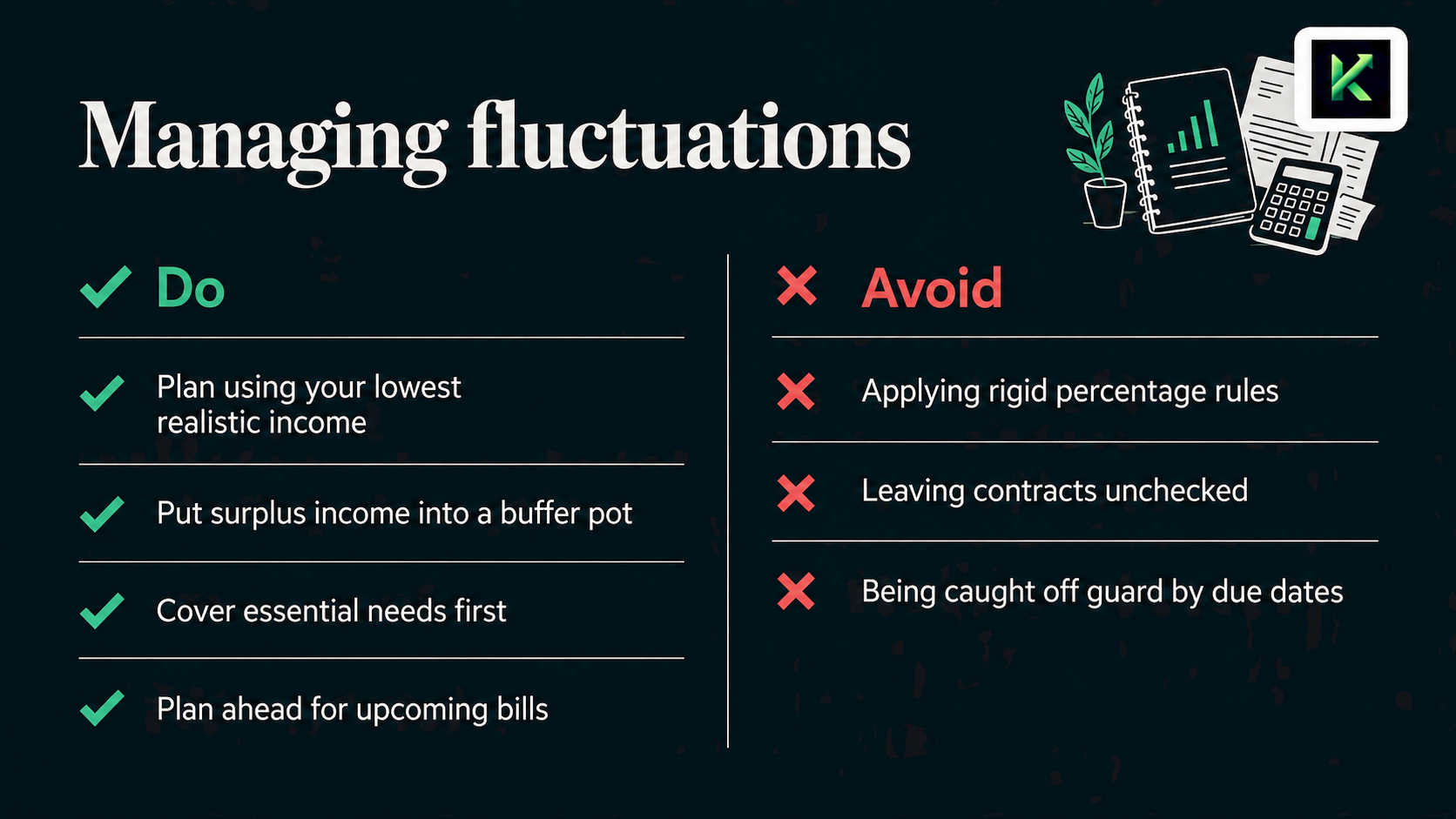
Variable income from self-employment, shift allowances or parental leave can push rigid percentage rules to their limits. A practical approach is to budget using your lowest realistic monthly income and put anything above that into a buffer pot to top up leaner months.
When costs rise, the approach recommended by Verbraucherzentrale Hamburg can help: rank spending by priority as unnecessary, essential or “nice to have”, and review contracts, memberships and subscriptions. Cover the essentials first: rent, water, electricity, food and maintenance payments.
The biggest advantage comes from looking ahead. If you know that vehicle tax is due in March and home contents insurance in June, you can plan for them rather than be caught off guard. A 24-month cash flow forecast that includes loan repayments can show you these shortfalls months in advance.
Budgeting with KRONO
KRONO brings budgets, accounts, debts, net worth and cash flow together in one iPhone-only app. Your data is stored locally on your device; couples and families can optionally share it through private iCloud household sharing. KRONO Free is free forever for up to 3 accounts, 2 loans and 1 monthly budget, giving you an overview and forecast without requiring a bank connection.

KRONO Pro unlocks unlimited accounts and loans, plus planning tools such as Monte Carlo simulation. An optional bank connection via Salt Edge is available only in Germany; elsewhere, use manual entry or CSV import. In Germany, Pro costs €6.99 per month or €69.99 per year. Prices elsewhere vary by region. You can find all the details on our pricing page.
Our view: the method is the starting point, clarity is the goal
We often find that asking for the right budgeting method is really a search for a single winning formula. Yet budgets rarely fail because of the method. They fail because the numbers are scattered: salary in a current account, loan repayments in your head, annual bills on a scrap of paper and savings at another bank.
That is why we built KRONO to keep budgets, accounts, debts and net worth in one place, with a forecast covering up to 24 months to show where your plan is heading. Our financial score assesses your situation using seven factors, so you can see not only what you spend but how healthy your finances are overall.
Privacy matters to us, especially for couples and families. Your data stays local, with optional sharing through your own private iCloud household sharing. And because major events such as having a child, buying a home or retiring change every budget, you can explore their impact in KRONO beforehand.
Choose the method that feels manageable today. We provide the clear overview that supports it.
Thomas
Frequently asked questions
Which budgeting method is easiest for beginners?
The 50/30/20 rule, because all you need is your take-home income and three percentages. Add a monthly comparison of planned and actual spending, and you will quickly see where adjustments are needed. Our budget calculator gives you the breakdown straight away.
How can couples with different incomes budget together?
A proven approach is the savings pot method with proportional contributions: each partner pays into the shared household pot according to their share of combined take-home income, while the rest remains personal. What matters is a shared overview that both partners can access at any time, for example through optional iCloud household sharing in KRONO.
How much of a buffer should a budget include?
Enough to avoid consistently ending the month with nothing left. Verbraucherzentrale recommends always allowing room for unexpected and urgent expenses. Create a separate category for this rather than hoping there will be money left over.
Do I need a bank connection to budget?
No. You can record expenses manually or import them by CSV. KRONO Free provides an overview without bank access and is free forever for up to 3 accounts, 2 loans and 1 monthly budget. KRONO Pro’s optional automatic bank connection via Salt Edge is available only in Germany and can save time if you make many card payments. In other countries, use manual entry or CSV import.
How often should I review my budget?
Ideally, record expenses daily or within a few days so that nothing is missed. Review the totals once a month and adjust your limits. It is also worth checking all contracts and subscriptions once a year.
Sources
- Verbraucherzentrale: Keeping a household spending record
- Verbraucherzentrale: Interactive budget planner
- Verbraucherzentrale: Module 3, What does life cost?
- Verbraucherzentrale Hamburg: Household budget
- Geld und Haushalt: The Simple Household Ledger
- German Society for Home Economics: Reference Budgets 2018