
Avoid Overdraft Debt: How to Get Out and Stay in Credit
The most reliable way to avoid using your overdraft comes down to three things: knowing each day how much money you really have available until payday, keeping a small buffer to absorb slip-ups before your account goes into the red, and planning for large expenses rather than borrowing through your overdraft to cover them. If you are already overdrawn, a fixed repayment plan with small, regular amounts can help. If you have been close to your overdraft limit for months, a cheaper installment loan may be an option—but only if your bank account stays in credit afterward. Here, we explain what an overdraft actually costs, how to get out of it step by step, and how to avoid building up credit card debt too.
The interest rates, banking rules, legal provisions, and advice services discussed below relate to Germany. Rules and costs differ by country. All euro calculations are illustrative examples, not local price or currency conversions.
At a glance
- Overdraft interest in Germany averages around 12 percent a year. Borrowing beyond an agreed overdraft limit often costs more than 15 percent.
- An overdraft becomes particularly expensive when a substantial negative balance remains for months and starts to feel normal.
- Prevention means keeping track of income and fixed expenses, building a small buffer after each payday, and working toward an emergency fund of around three months’ take-home pay.
- A regular repayment schedule helps you get out. If you have used almost your entire overdraft for more than six months, it is worth comparing the cost with an installment loan.
- It is best to pay your credit card bill in full every month, because carrying a balance attracts high interest.
Contents
- What an overdraft really costs
- Signs that using your overdraft is becoming a habit
- Avoiding overdrafts: six habits that keep your account in credit
- Getting out of your overdraft: a five-step plan
- Refinancing an overdraft: when an installment loan can help
- What happens if you stay overdrawn
- Avoiding credit card debt
- Our perspective: looking ahead helps you leave your overdraft behind
- Keeping track of your overdraft with KRONO
- Frequently asked questions about overdrafts
- Sources
What an overdraft really costs
An arranged overdraft is a borrowing limit your bank gives you on your current account. It has no fixed end date, and each bank sets its own variable interest rate. According to VerbraucherService Bayern, overdraft interest averages twelve percent a year. If you borrow beyond the agreed limit, this is known in Germany as a tolerated, or unarranged, overdraft. Banks frequently charge even more for this, often over 15 percent a year.
This illustrative calculation shows what that means in euros at an interest rate of 12 percent:
| Overdrawn balance | Monthly interest (approx.) | Annual interest (approx.) |
|---|---|---|
| €500 | €5 | €60 |
| €1,500 | €15 | €180 |
| €3,000 | €30 | €360 |
| €5,000 | €50 | €600 |
Being €200 overdrawn for a few days therefore costs only a matter of cents. The real problem is different: a negative balance of €1,500 or €3,000 that remains for a year can cost as much as a weekend away, with nothing to show for it. There is a psychological effect too. A €3,000 installment loan feels like a debt you need to repay. A bank balance of minus €3,000, on the other hand, can quickly become your new zero. Your salary arrives, your account briefly moves into credit—or simply becomes less overdrawn—and by the end of the month you are back where you started.
Signs that using your overdraft is becoming a habit
Many people do not fall into their overdraft because of one large expense. It happens gradually. Common warning signs include:
- Your balance regularly turns negative before the end of the month.
- Your salary only clears the negative balance rather than leaving money over.
- You avoid checking your balance because you do not want to see the number.
- Annual insurance premiums, vehicle tax, or additional utility charges catch you off guard year after year.
- Alongside your overdraft, you also have an outstanding credit card balance or an installment purchase to repay.
If more than one point applies to you, it is worth taking action now. The sooner you start, the smaller the amount you will need to repay.
Avoiding overdrafts: six habits that keep your account in credit
The Association of German Banks recommends first getting a clear picture of your balance, regular income, and expenses, then prioritizing spending and building an emergency fund. You can turn that advice into practical routines.
1. Work with the money that is genuinely available
Your balance at the beginning of the month can be misleading. Rent, electricity, your phone plan, subscriptions, and insurance still need to come out. Subtract all fixed expenses due before your next payday from your balance, then divide what remains by the number of days left. That gives you your daily budget. Our free available money calculator does this in a few seconds.
2. Give every euro a job
A budget stops variable expenses such as eating out, online shopping, and impulse purchases from emptying your account. The 50/30/20 rule is a useful starting point: 50 percent for needs, 30 percent for wants, and 20 percent for saving and repaying debt. If you are overdrawn, overdraft repayment belongs in that 20 percent. Our 50/30/20 budget calculator automatically divides up your take-home income.
3. Make a small buffer part of your routine
Raiffeisenbank recommends keeping a small buffer, for example by moving €100 into an easy-access savings account after each payday. That may not sound like much, but it catches exactly the slip-ups that would otherwise trigger an overdraft: a forgotten direct debit, filling the car on the 28th, or a birthday present.
4. Build an emergency fund
Over time, an emergency fund replaces your overdraft as a safety net. The Association of German Banks suggests aiming for three months’ take-home pay. In an illustrative example with net monthly income of €2,400, that means €7,200. You will not build it in a month, but a standing order for €150 straight after payday will help it grow steadily. A broken washing machine then becomes an annoying expense rather than an overdraft trap.
5. Plan ahead for large and irregular expenses
Write down all annual and half-yearly payments: car insurance, Germany’s broadcasting contribution (formerly known as the GEZ fee), club memberships, utility bill adjustments, holidays, and Christmas. Divide the total by twelve and set aside that amount each month. Looking several months ahead at your cash flow helps you spot shortfalls before they happen. Our guide to assets, debts, and cash flow explains what this looks like in practice.
6. Choose your overdraft limit deliberately
A generous overdraft is not a gift from your bank—it is an invitation to borrow. Check24 recommends avoiding using your full limit and checking account activity regularly. Once you have cleared your negative balance, you can ask your bank to reduce the limit. That leaves an emergency safety net without so much room for temptation.
Getting out of your overdraft: a five-step plan
VerbraucherService Bayern outlines a clear route out of the overdraft trap: assess your situation, seek help if you feel overwhelmed, put measures in place and change your spending habits, and talk to your bank. Here is how to put that into practice.
- Take stock. Write down your current overdraft balance, the interest rate, all other debts—including credit cards, installment purchases, and private loans—and your monthly income and fixed expenses. Only with these figures can you work out how much you can repay each month.
- Set a fixed repayment amount. Choose a schedule: either monthly, straight after payday, or weekly in smaller amounts. Set small, achievable milestones, such as first reaching minus €1,000, then minus €500.
- Cut expenses where it hurts least. Cancel subscriptions you barely use, compare electricity and phone plans, and prepare meals ahead more often. Every euro saved goes straight toward repayment.
- Increase your income where possible. Sell things you no longer use, take on a small side job, or check whether you are entitled to a tax refund. Put one-off payments such as holiday or Christmas bonuses entirely toward clearing the negative balance.
- Talk to your bank. Explain your situation early. Your bank has an interest in seeing you repay what you owe and may be able to offer alternatives.
An illustrative calculation
Suppose your account is €2,400 overdrawn and, after reviewing your budget, you have €250 left over each month. If you consistently put that €250 toward repayment and do not borrow more, you will be out in roughly ten months, before allowing for the exact effect of interest. Interest charges fall each month as the negative balance shrinks. The crucial point is this: new expenses must not increase the debt again. That is why you need the daily budget described in the first habit above.
When you need help
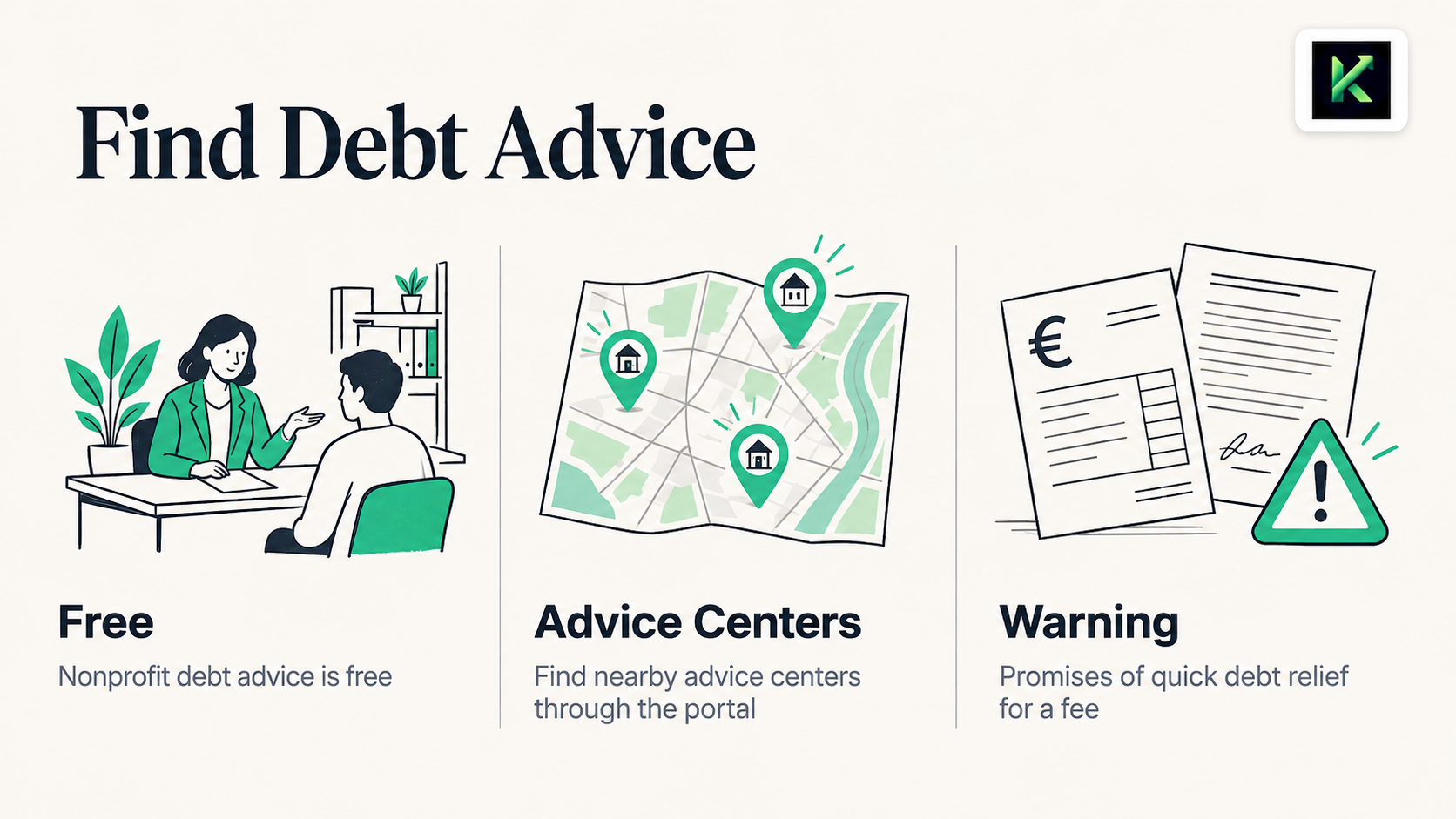
If you have several debts, payment reminders are arriving, or your income no longer covers fixed expenses, seek support from a nonprofit debt advice service. In Germany, examples include the Verbraucherzentrale consumer advice centers, Caritas, Diakonie, or your local authority. The Association of German Banks points to meine-schulden.de, a portal run by the German Federal Association for Debt Advice, where you can find nearby advice centers. Nonprofit advice is free to you. Be wary of commercial services promising a quick escape from debt in exchange for a fee. Outside Germany, look for an equivalent nonprofit service in your country.
Refinancing an overdraft: when an installment loan can help
If your negative balance has remained for months, an installment loan is often cheaper. Verbraucherzentrale Hamburg notes that a straightforward installment loan can leave you considerably better off than an overdraft. Raiffeisenbank offers this rule of thumb: an installment loan is worth considering if you have used your overdraft for more than six months and are at or close to the maximum limit.
There is even a legal requirement in Germany. Under Section 504a of the German Civil Code (BGB), your bank must offer advice on cheaper alternatives if you have used your overdraft continuously for six months and, on average, borrowed more than 75 percent of your agreed limit. Finanztip recommends considering other options rather than simply accepting your own bank’s offer.
| Criterion | Arranged overdraft | Borrowing beyond the agreed limit | Installment loan |
|---|---|---|---|
| Typical interest in Germany | Around 12% a year on average | Often more than 15% a year | Usually considerably cheaper than an overdraft |
| Term | No fixed end date | None; the bank can demand immediate repayment | Fixed by agreement |
| Repayment | Flexible, with no set plan | Expected immediately | Fixed monthly payment |
| Predictability | Low | Very low | High |
| Suitable for | Short cash shortfalls lasting a few days | Best avoided wherever possible | A negative balance that has persisted for months |
What to compare before refinancing
- Annual percentage rate and total cost: The effective annual interest rate, or APR, is the figure to use when comparing offers. Germany’s Federal Ministry for Family Affairs recommends getting terms from several banks and consulting independent comparisons from Stiftung Warentest or consumer advice centers.
- An affordable payment: The repayment must fit your budget, including in a month with extra expenses.
- Early repayment: Check whether you can make additional payments and what it would cost to settle the loan early.
- No unnecessary extras: Payment protection insurance often makes a loan noticeably more expensive. Read the contract before signing.
- Do not use the overdraft again afterward: This is the most important point. If you refinance and then go overdrawn again, you end up with two debts instead of one. Ask for your limit to be reduced once the overdraft is cleared.
If you borrow from family or friends, put the amount, repayment arrangements, and any interest in writing. That protects your relationship as well as your finances.
What happens if you stay overdrawn
An overdraft is not a permanent entitlement. According to Finanztip, a German bank can reduce or withdraw it, generally with two months’ notice, and in some circumstances without notice. The entire negative balance then becomes due at once. norisbank points out that prolonged or excessive borrowing beyond the agreed limit can lead to a negative entry with SCHUFA, Germany’s credit reference agency. The bank may send payment reminders, block the account, and ultimately close it. A negative SCHUFA entry can make it harder to obtain a rental agreement, phone contract, or financing later. At the latest, speak to your bank or a debt advice service when the first payment reminder arrives.
Avoiding credit card debt
Credit cards are another way many people build up debt without noticing. With revolving credit cards in particular, where you pay only a minimum amount each month, the outstanding balance can quietly keep growing. The Verbraucherzentrale recommends paying your credit card bill in full as soon as it is due, because paying in installments attracts high interest.
In a research report from the Federation of German Consumer Organisations, debt advisers describe credit card debt as a common issue. Minimum payments ease the immediate pressure on your account but extend the repayment period. Each additional card also makes it harder to keep track. Here is how to stay in control:
- Set up full repayment: Switch from partial repayment to paying 100 percent of the statement balance, if your card offers that option.
- Include card spending in your budget: A credit card purchase is an expense this month, even if the payment leaves your account later. Deduct it from your available money immediately.
- One card is enough: Cancel second or third cards you do not need.
- Know the payment date: The monthly card payment often leaves your account around the middle of the month. If the timing is awkward, it can push your current account straight into its overdraft.
- Pay down existing debt first: If you have an outstanding card balance, treat it like overdraft debt and budget for a fixed monthly repayment well above the minimum.
Prepaid cards can be suitable for teenagers because spending is limited to the money loaded onto the card rather than borrowed credit.
Our perspective: looking ahead helps you leave your overdraft behind
We see the same pattern among our users time and again: overdraft use rarely starts with carelessness. It happens because today’s balance tells you nothing about your balance in three weeks. The annual insurance premium, the credit card payment, the additional utility bill—these are all known expenses, but they are not brought together in one place.
That is why we built KRONO to help you look forward, not just back. The cash flow forecast shows when money may get tight up to 24 months ahead. You can spot a March shortfall in December and take action before the bank charges interest. Debts such as an overdraft balance or a refinancing loan sit alongside your accounts and budget, so you can track repayment month by month.
It matters to us that your financial data belongs to you. KRONO stores it locally on your iPhone, and couples or families who plan together can optionally share their household privately through iCloud. The basic version remains free forever, with up to 3 accounts, 2 loans, and 1 monthly budget. Avoiding an overdraft takes more than discipline; it takes clarity.
Thomas
Keeping track of your overdraft with KRONO
With KRONO, you record income, expenses, accounts, and debts in one place. Your personal financial overview shows how your cash flow develops over the coming months. Our financial score assesses your situation using seven factors, and monthly PDF reports help you see whether your repayment plan is working.
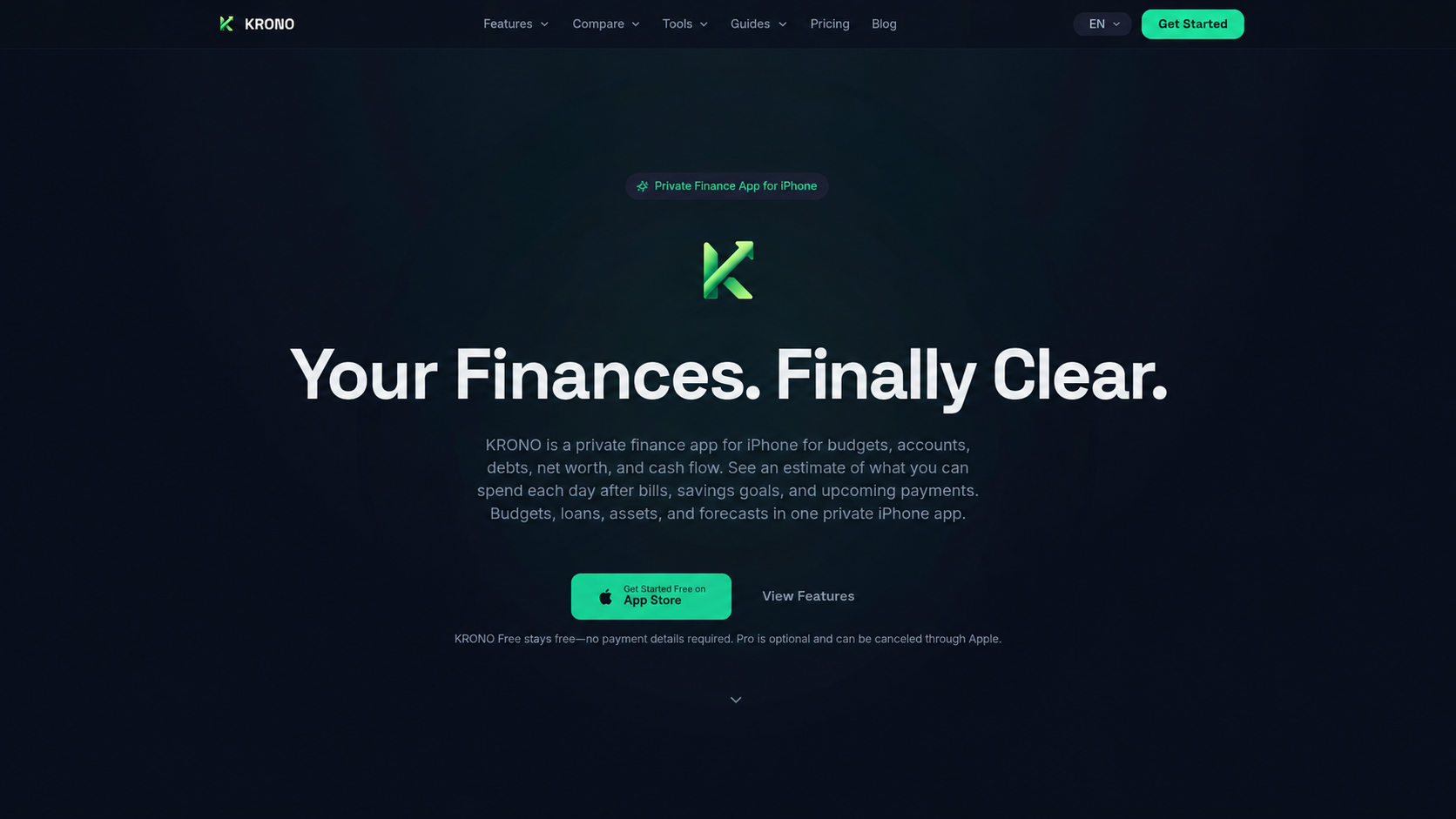
KRONO is available only on iPhone. KRONO Free is free forever, with no subscription required, for up to 3 accounts, 2 loans, and 1 monthly budget. KRONO Pro adds features including unlimited accounts and loans and planning tools with Monte Carlo simulation. Optional bank connection for automatic transaction imports is available only in Germany through Salt Edge; in other countries, use manual entry or CSV import. In Germany, Pro costs €6.99 per month or €69.99 per year; elsewhere, prices vary by region. All details are on our pricing page. If you are planning as a couple, our guide to household budgeting for couples and families shows you how to set up a shared budget.
Private household sharing through iCloud is optional. AI features are off by default and available only with Pro on a compatible iPhone with Apple Intelligence. Processing takes place on-device, and actions require your confirmation. Safe to Spend is an estimate, not a guarantee of what you can afford.
Frequently asked questions about overdrafts
How far can I overdraw my account?
You can borrow up to your agreed overdraft limit and pay overdraft interest on that borrowing. Anything beyond it is an unarranged overdraft, which the bank may allow but is not obliged to permit, and which is usually more expensive. If the bank declines it, direct debits or card payments will not go through.
Does an overdraft result in a SCHUFA entry?
Using an arranged overdraft within its limit is not a negative SCHUFA entry. Problems can arise if you exceed the limit significantly or for a prolonged period and ignore payment reminders. A negative entry may then follow. SCHUFA is a German credit reference agency; other countries have different credit reporting systems.
How long does it take to clear an overdraft?
That depends on the amount you owe and your monthly surplus. Divide your overdraft balance by the amount you can reliably repay each month for a useful starting estimate, then allow for interest. In the illustrative example of €2,400 owed and monthly repayments of €250, it is around ten months before the exact effect of interest, provided you do not borrow more.
Can I remove my overdraft entirely?
Yes. Once you have cleared the balance, you can ask your bank to reduce or remove the limit. Alternatively, you can use an account that only allows spending from a positive balance. If you have an emergency fund, you generally no longer need an overdraft as your safety net.
Is refinancing always better than an overdraft?
For a negative balance that has persisted for months, an installment loan is usually cheaper and more predictable. But it only makes sense if the repayments fit your budget and you do not start using the overdraft again afterward. Compare the APR of several offers first.
Sources
- VerbraucherService Bayern: Getting your finances under control—ways out of the overdraft trap
- Association of German Banks: Avoiding high overdraft interest
- Raiffeisenbank: High overdraft interest
- Check24: Overdrawing your account—requirements and consequences
- Verbraucherzentrale Hamburg: Beware of credit traps
- Finanztip: Overdrawn? How to clear your balance
- BMBFSFJ: What should I do about my debts?
- norisbank: An overdrawn account
- Verbraucherzentrale: Credit card factsheet
- vzbv: Study of the causes of debt and over-indebtedness