
Achieve Financial Independence: Your 6-Step Plan

You are financially independent when your assets and income that does not depend on work can cover your expenses over the long term. Getting there follows a clear sequence: understand your actual expenses, use them to calculate your target amount, set a savings rate you can sustain, and invest the surplus in a diversified portfolio over many years. How long it takes depends primarily on your savings rate, rather than your income alone. Here you will find the calculations, realistic figures for Germany, and a plan you can follow on your own, as a couple, or as a family. The euro examples and German tax and insurance rules below retain their original context; rules elsewhere will differ.
At a glance
- Expenses come first: Your target depends on your living costs. Without an accurate picture of them, you are planning in the dark.
- A rule of thumb for your target: 25 times your annual expenses—the 4% rule. Anyone planning to retire early in Germany should use a more cautious estimate of 28 to 33 times annual expenses.
- Your savings rate sets the pace: At a 10% savings rate, it takes roughly 50 years; at 50%, about 17 years, assuming a 5% return after inflation. These are illustrative projections.
- Security before freedom: Build an emergency fund and pay off consumer debt before investing in earnest.
- Review regularly: A monthly look at your net worth and cash flow keeps your plan on track, especially when planning together.
Contents
- What financial independence really means
- Step 1: Take an honest look at your starting point
- Step 2: Calculate your target amount
- Step 3: Set your savings rate and timeline
- Step 4: Cut expenses and increase income
- Step 5: Invest and make use of retirement benefits
- Step 6: Plan together as a couple or family
- Milestones that keep you motivated
- Our perspective on the path to independence
- Put your plan into action with KRONO
- Frequently asked questions
- Sources
What financial independence really means
These terms are often used interchangeably. Consorsbank offers a useful definition: financial freedom means withdrawals from your assets and other income not dependent on employment are expected to cover your expenses indefinitely, after allowing for taxes, inflation, and a safety margin. There is no single target amount that works for everyone.
In practice, it helps to distinguish three stages:
| Stage | What you have achieved | What changes for you |
|---|---|---|
| Financial security | An emergency fund is in place, with no consumer debt | A broken washing machine or a job change will not push you into debt |
| Financial independence | Your assets can cover your fixed costs for an extended period | You still work, but can choose part-time work, a sabbatical, or a career change |
| Financial freedom | Investment income covers all living costs over the long term | Work becomes optional |
These stages are not just theory; they are milestones. Even the first changes the way you make decisions. And someone who reaches the second negotiates with their employer from a different position than someone who depends on every monthly paycheck.
Step 1: Take an honest look at your starting point
Every plan starts with taking stock. In its guidance on financial planning, F.A.Z. recommends first writing down your income, expenses, assets, and debts. Costs that are not paid monthly are easy to overlook: annual car insurance, vehicle tax, or club membership fees. Convert these into monthly amounts, or you will consistently underestimate your costs.
Here is how to proceed:
- Record your income: Take-home pay, child benefits, rental income, and side jobs.
- List fixed costs: Rent or loan payments, insurance, contracts, and subscriptions.
- Track variable expenses: Groceries, transport, and leisure. Three months of actual figures are better than any estimate.
- Subtract debts from assets: Account balances, investments, and property, minus loans, give you your net worth. Our net worth calculator does this in a minute.
- Work out your monthly surplus: The difference between regular income and average expenses is the money available for reserves and goals.
Net worth is your most important measure along the way. It shows whether you are making progress, even when individual account balances move in different directions. Our guide to planning assets, debt, and cash flow explains how they fit together.
Step 2: Calculate your target amount
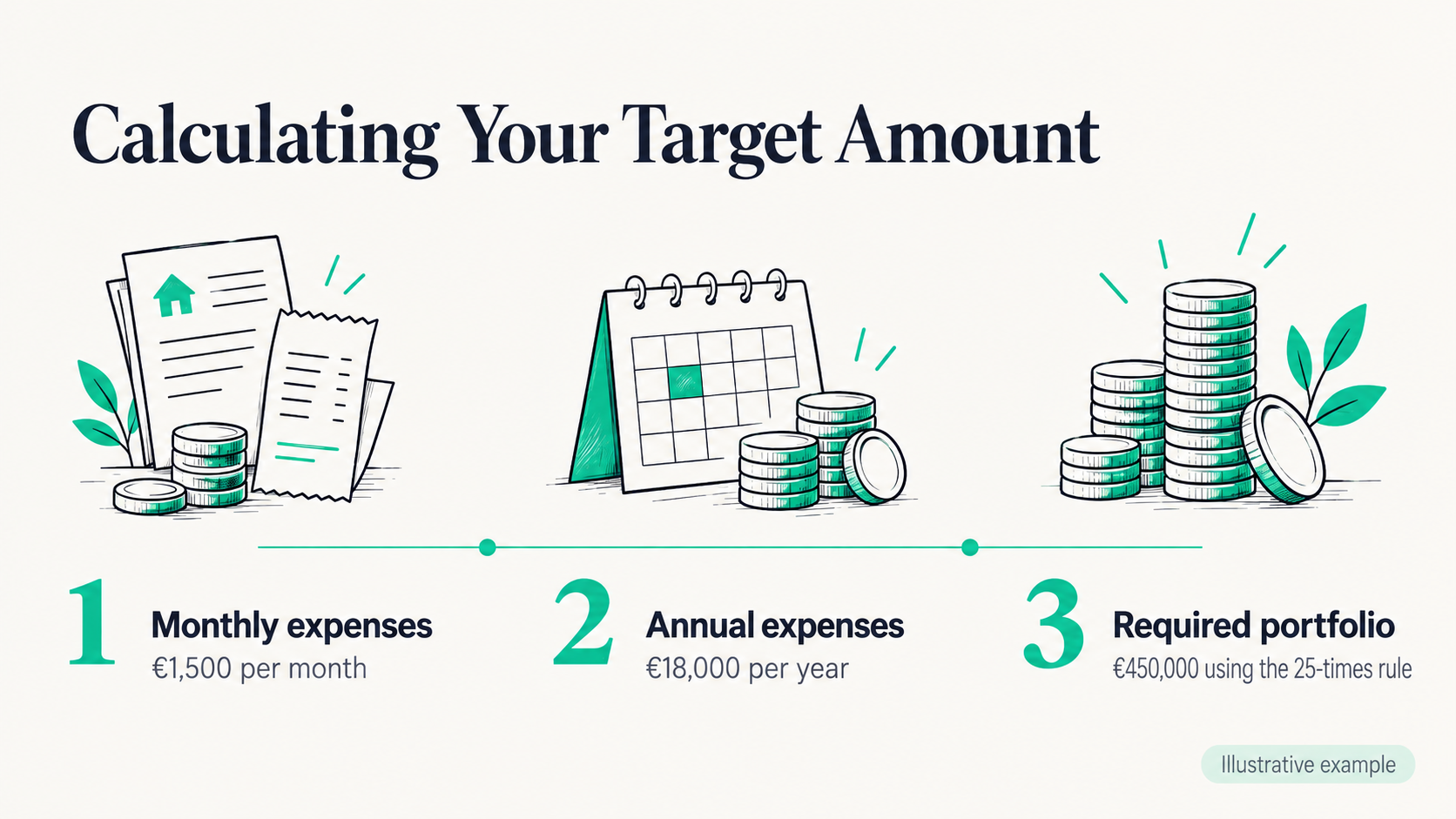
The best-known rule of thumb is the 4% rule. It comes from a study by William Bengen in 1994: historically, people who withdrew 4% of their portfolio in the first year and adjusted that amount for inflation afterward had a good chance of their money lasting around 30 years. According to ING, this implies a portfolio target of 25 times your desired annual spending. As an illustrative example, spending €1,500 a month, or €18,000 a year, gives a target of €450,000.
For comparison, the average household in Germany spent €2,846 a month in 2022, according to Germany's Federal Statistical Office. Under the 25-times rule, that would mean just over €850,000.
Why planning in Germany calls for more caution
The 4% rule is based on US data and a 30-year withdrawal period. Three additional points matter when applying it in Germany:
- A longer time horizon: Someone retiring at 45 often needs their money to last 40 years or more. Many planners therefore use a withdrawal rate of 3% to 3.5%, or roughly 28 to 33 times annual expenses.
- Taxes: Investment income is subject to Germany's flat-rate investment income tax. In an unfavorable case, the tax burden on taxable investment income in later withdrawals can be nearly 28%. Include tax in your spending plan; this does not mean every euro withdrawn is taxable.
- Health insurance: Without an employer, you pay the contributions yourself. If you are voluntarily insured under Germany's statutory system, investment income can also count toward contributions. Include this as a separate line in your calculation. Before leaving your job, ask your health insurer or a tax adviser to confirm the amount for your circumstances.
Illustrative calculation
| Monthly expenses | Annual spending | Target at 4% (×25) | Target at 3.5% (×28.6) |
|---|---|---|---|
| €1,500 | €18,000 | €450,000 | €514,300 |
| €2,000 | €24,000 | €600,000 | €685,700 |
| €2,800 | €33,600 | €840,000 | €960,000 |
| €3,500 | €42,000 | €1,050,000 | €1,200,000 |
These figures are a starting point, not a promise. If your expenses change, your target changes with them. That is why it is worth recalculating every year rather than working it out once and forgetting about it.
Step 3: Set your savings rate and timeline
Your savings rate is the share of your take-home income that you invest rather than spend. As Consorsbank explains, it has a double effect when it comes from lower spending: you invest more each month while also reducing the amount your assets will eventually need to cover.
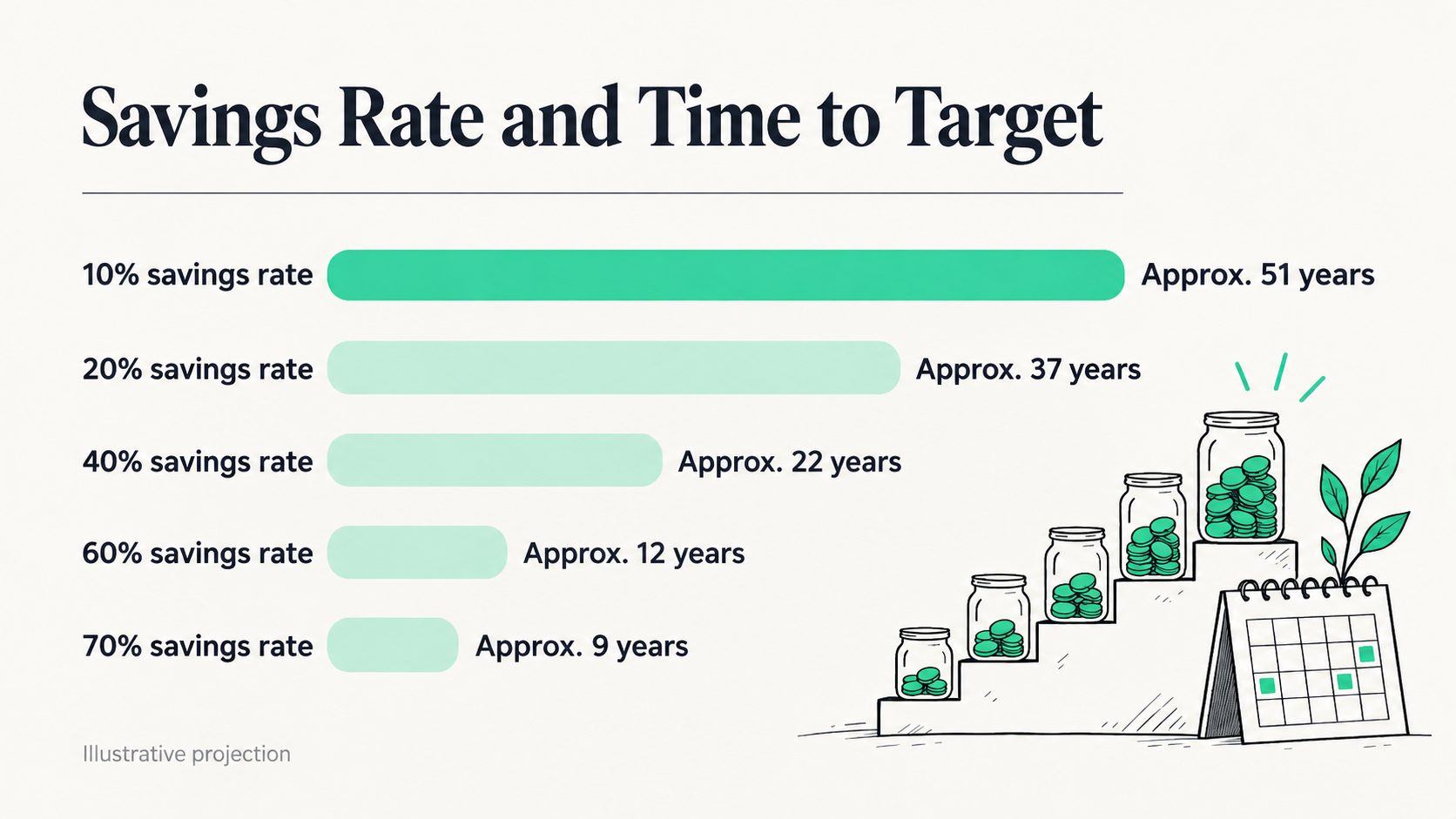
The following illustrative table shows approximately how many years it takes to accumulate 25 times your annual expenses. Assumptions: starting from zero, a 5% annual return after inflation, and constant spending.
| Savings rate | Years to reach your target |
|---|---|
| 10% | Approx. 51 |
| 20% | Approx. 37 |
| 30% | Approx. 28 |
| 40% | Approx. 22 |
| 50% | Approx. 17 |
| 60% | Approx. 12 |
| 70% | Approx. 9 |
For context, people in Germany save around 11% of their income on average, while followers of extreme frugality often save 60% to 70%. Rates like these are most realistic for high earners. Someone earning €1,800 spends a large share of that on rent.
A realistic approach for most people is to increase the rate gradually. Put half of every pay rise into your regular investment plan before your lifestyle adjusts to it. This can turn 15% into 25% over a few years without cutting your current spending.
Here is an illustrative example: you have €20,000 in starting capital, invest €1,500 a month, and want to reach €840,000 to cover monthly expenses of €2,800. At a 5% real return, that takes around 24 years. Investing €2,000 a month with no starting capital takes about 20 years.
Step 4: Cut expenses and increase income
There are two things you can work on: what goes out and what comes in.
Cut expenses without making life miserable
Germany's consumer advice service, Verbraucherzentrale, recommends reviewing recurring costs, canceling unused contracts, comparing insurance policies, and tracking variable expenses in a spending log or app. Check weekly or every other week what you can remove or replace with a cheaper option.
The biggest opportunities are usually here:
- Housing: Usually the largest expense. Moving to a smaller home or the outskirts of a city often saves more than all the other measures combined.
- Transport: In Germany, consider the Deutschlandticket public transport pass, car sharing, or cycling instead of a second car.
- Contracts: Review mobile phone, electricity, gas, and insurance contracts annually.
- Everyday spending: Small amounts add up. According to Umweltbank, a daily takeaway coffee can cost around €80 a month.
A clear allocation helps you avoid agonizing over every purchase. Our 50/30/20 budget calculator divides your income between fixed costs, wants, and savings. If you want to make faster progress, shift more of the allocation toward savings.
Increase your income
There is a limit to how much you can cut spending; income has more room to grow. Negotiating your salary, taking training that leads to a clear pay increase, changing jobs, or earning money on the side often does more than canceling yet another contract. The key is to channel the extra money straight into your investment plan rather than letting it disappear into everyday spending.
Step 5: Invest and make use of retirement benefits
Leaving money in a checking account will not get you to your goal on its own. If the after-tax interest rate is below inflation, your savings lose purchasing power. According to Consorsbank, a regular investment plan using broadly diversified ETFs can itself be a viable strategy for building wealth over the long term, whether for conventional retirement or an earlier exit from work. Market fluctuations are part of the process.
A tried-and-tested order is:
- Build an emergency fund: We recommend keeping three months of expenses for employees and six months for self-employed people in an easy-access savings account.
- Pay off expensive debt: Overdrafts and installment loans cost more than an investment portfolio can reliably earn.
- Use available retirement incentives: In Germany's occupational pension system, contributions of up to 8% of the relevant contribution assessment ceiling are tax-free in 2026: €8,112 a year, with up to €4,056 exempt from social insurance contributions. If your employer contributes too, that is an additional benefit.
- Invest broadly: Set up a monthly investment plan in globally diversified ETFs, executed automatically the day after your salary arrives.
Use conservative return assumptions. Do not build your plan around more than 5% a year after inflation. Tagesschau quotes an expert whose calculations found that, with a higher equity allocation, the money lasted in 95% of cases—but that this should not be treated as a 100% guarantee. Before reallocating a large portfolio or leaving your job, seek independent fee-only financial advice or guidance from a consumer advice service.
Step 6: Plan together as a couple or family
Two people can often reach the goal faster: two incomes and shared fixed costs. But this requires agreement.
- Define a shared goal: What does independence mean to you? Retiring earlier, working part-time, or taking a year off with the children? Write it down, including an amount and a date.
- Choose an account setup: One proven approach is a joint account for rent, groceries, and regular investments, plus two individual accounts for personal spending. The higher earner contributes proportionally more.
- One figure for both of you: Track your combined net worth rather than two separate snapshots. This avoids arguments about whose account looks better at a particular moment.
- Plan for life events: Parental leave, buying a home, or changing jobs can shift your plan by years if you do not account for them in advance. Our guides to parental leave and household budgeting and planning your down payment for a home explain how.
- Hold a monthly money meeting: Set aside 30 minutes at the beginning of the month. What came in, what went out, how did your net worth change, and is your monthly savings amount still realistic?
Milestones that keep you motivated
The journey takes years. Focusing only on the final amount can quickly drain your motivation. The FIRE movement—Financial Independence, Retire Early—has several stages and variations described by heise: Lean FIRE with a minimalist lifestyle; Barista FIRE, using part-time work as a bridge; Coast FIRE, where existing investments grow until retirement without further contributions; and Fat FIRE, which supports a higher standard of living. You can switch between these approaches as your life changes.
Useful milestones include: fully funding your emergency reserve, paying off your last consumer debt, reaching your first €100,000 in net worth, covering one year's expenses, and reaching your Coast FIRE point.
Our perspective on the path to independence
Every day, we see what really causes financial independence plans to fail: not choosing the wrong ETF, but lacking a clear overview. If you do not know what you actually spend, you end up working with the wrong target and a savings rate you cannot maintain.
That is why we built KRONO to bring budgets, accounts, debts, net worth, and cash flow together in one place. Forecasts covering up to 24 months show where your current savings rate may lead before you see it in your account balance. Our financial score assesses seven factors to help you see where you stand.
Finances are private. That is why KRONO stores your data locally on your iPhone, with optional private iCloud sharing for couples who want to share their household. The free version gives you an overview without a subscription and remains free forever for up to 3 accounts, 2 loans, and 1 monthly budget. KRONO Pro adds advanced long-term planning tools, including Monte Carlo simulations. Optional bank connections are available only in Germany, through Salt Edge; in other countries, use manual entry or CSV imports.
Thomas
Put your plan into action with KRONO
With KRONO, you can see how your income, expenses, and net worth develop on your iPhone and include life events such as having a child, buying a property, or retiring directly in your plan. KRONO is iPhone-only. KRONO Free gives you an overview without a subscription and is free forever for up to 3 accounts, 2 loans, and 1 monthly budget. Your data is stored locally, with optional private iCloud household sharing.
KRONO Pro unlocks unlimited accounts and loans, along with advanced planning tools including Monte Carlo simulation. Optional bank connections are available only in Germany through Salt Edge; elsewhere, use manual entry or CSV imports. In Germany, Pro costs €6.99 a month or €69.99 a year; prices elsewhere vary by region. You can find all the details on our pricing page.
Frequently asked questions
How much money do I need to be financially independent?
A common rule of thumb is 25 times your annual expenses. As an illustrative example, spending €2,000 a month gives a target of €600,000. If you want to retire very early and account for German taxes and health insurance, plan on 28 to 33 times annual expenses.
Can you become financially independent on an ordinary salary?
Yes, but it takes longer. In an illustrative projection with a 20% savings rate and a 5% real return, reaching the full target takes around 37 years. You can reach intermediate goals such as Coast FIRE or Barista FIRE much sooner, and every pay rise you invest shortens the journey.
How often should I review my plan?
Review expenses, your savings amount, and net worth once a month, and your target amount once a year. If your circumstances change—for example, with a new child, a move, or a job change—recalculate straight away.
What is the difference between financial independence and financial freedom?
Using the stages outlined here, financial independence means your assets can cover your fixed costs for an extended period: you still work, but have more choices. Financial freedom means investment income covers all your living costs over the long term, making work optional.
Sources
- Consorsbank: Achieving financial freedom
- F.A.Z. Kaufkompass: Creating a financial plan
- ING: Financial security with the 4% rule?
- tagesschau.de: Retiring at 40—how realistic is financial freedom?
- tagesschau.de: Retiring at 40—what makes frugalists financially independent?
- heise: Retiring earlier with the FIRE approach
- Verbraucherzentrale: Finding ways to save
- Umweltbank: Frugalism—saving for financial freedom
- Checkfox: Comparing retirement insurance products